
August 22, 2008
Vladimir Mamaev
GEF Regional Technical Advisor, Europe and the CIS
United Nations Development Programme
Bratislava Regional Centre
Grosslingova 35
Bratislava, Slovak Republic
81109
Dear Vladimir:
The Global Environment & Technology Foundation (GETF) is pleased to provide the attached
project document for the UNDP-GEF approved 24 month Medium-Size Project (MSP) entitled,
"Promoting Replication of Good Practices for Nutrient Reduction and Joint Collaboration in Central
and Eastern Europe." This project document summarizes the key strategies, deliverables, time frame
and budget required to begin MSP execution.
Please note: (1) The proposed work plan, potential deliverable due dates, and budget are weighted for
significant upfront work during year one. Therefore, we request your consideration of a
reapportionment of funding to meet this higher year one level of effort by dispersing two-thirds of
the funding during year one and one-third during year two as opposed to the current allocation
which proposed more funding during year two; and (2) we will be able to confirm the official
contract start date, called for in the legal context, upon finalizing the Project Document and
subsequent contract agreement with UNDP. We anticipate this to occur in September 2008.
We look forward to working closely with you and Andy to finalize the project document as soon as
possible. Chuck Chaitovitz, who will be serving as GETF's project manager, will follow-up shortly
with you to discuss how best to proceed. Please do not hesitate to contact me should you require
additional information. Thank you again for your assistance in this matter.
Warm regards,
Monica Ellis
CEO
UNDP Project Document
UNDP-GEF Medium-Size Project (MSP)
Global Environment & Technology Foundation
United Nations Development Programme
Promoting Replication of Good Practices for Nutrient Reduction and Joint Collaboration in Central
and Eastern Europe
Brief description
This project will accelerate the replication of successful nutrient reduction projects in Central
and Eastern Europe. This will be done by: i) identifying, capturing, analyzing and
summarizing nutrient reduction best practices and lessons learned in the region; ii)
demonstrating successful replication strategies by facilitating the replication of an agricultural
practices project and a wetlands project in the region; and iii) disseminating and promoting
nutrient reduction best practices and success replication strategies in Central and Eastern
Europe as well as the Black Sea and Caspian Sea basins.
TABLE OF CONTENTS
SECTION 1: ELABORATION OF THE NARRATIVE ........................................................................... 1
PART I: Situation Analysis .................................................................................................................. 1
PART II: Strategy ................................................................................................................................. 1
PART III: Management Arrangements .............................................................................................. 3
PART IV: Monitoring and Evaluation Plan and Budget .................................................................. 5
PART V: Legal Context ....................................................................................................................... 6
SECTION II: STRATEGIC RESULTS FRAMEWORK.......................................................................... 7
PART I: Logical Framework Analysis ............................................................................................... 7
COMPONENT 1 .................................................................................................................................... 7
COMPONENT 2 .................................................................................................................................... 9
COMPONENT 3 .................................................................................................................................. 10
SECTION III: TOTAL BUDGET AND WORKPLAN .......................................................................... 16
SECTION IV: ADDITIONAL INFORMATION ................................................................................... 20
Acronyms
BRC UNDP Bratislava Regional Centre
CAP-NET Capacity Building for International Waters Resource Management Program
CARNet - Central Asia and Russia Environment and Sustainable Development Network
CD-ROM Computer Disc-Read Only Memory
CEE - Central and Eastern Europe
CIS - Commonwealth of Independent States
COP - Community of Practice
ECCA Europe, Caucasus and Central Asia
EEA European Environmental Agency
EU European Union
GEF - Global Environment Facility
GETF - Global Environment & Technology Foundation
GPA Global program for Action for the Protection of the Marine Environment from Land-based
Activities
GWP - Global Water Partnership
HDR Human Development Report
IA Global Environment Facility Implementing Agency
IPCC - Integrated Pollution Prevention and Control Directive
IW International Waters
IW:LEARN International Waters Learning Exchange and Resource Network
IWRM - Integrated Water Resources Management
KM Knowledge Management
LME Large Marine Ecosystem
M&E Monitoring and Evaluation
NAP National Action Plan
NGO Non-Governmental Organizations
NRIF World Bank Nutrient Reduction Investment Fund
POPs - Persistent Organic Pollutants
RBEC UNDP Regional Bureau of Europe and the Commonwealth of Independent States
REC - Regional Environmental Center for Central and Eastern Europe
REC Caucasus - Regional Environmental Center - Caucasus
REC Moldova - Regional Environmental Center Moldova
REC Russia - Regional Environmental Center - Russia
SAP Strategic Action Plan
TDA Transboundary Diagnostic Analysis
TWM Transboundary Waters Management
TWM GP&LL Transboundary Waters Management Good Practices/Lessons Learned
UNDP United Nations Development Program
UNECE United Nations Economic Commission for Europe
UNEP United Nations Environmental Program
URL Uniform Resource Link (web link address)
WFD Water Framework Directive
WB World Bank
SECTION 1: ELABORATION OF THE NARRATIVE
PART I: Situation Analysis
The project aligns with GEF 4's call for a move from a testing and demonstration mode to scaling-up of
full operations in support of agreed incremental costs of reforms, investments, and management
programs needed to reduce stress on transboundary freshwater and marine systems. The project is in
alignment with GEF 4's increased emphasis on targeted experience sharing and learning among the new
and existing GEF IW projects in the portfolio, peer-to-peer sharing among IW projects, development of
knowledge management tools to capture good practices, and accelerated replication of good practices. In
addition, the project aligns with GEF/C.27/13, GEF Strategy to Enhance Engagement with the Private
Sector, by engaging the private industry in sectors related to nutrient reduction, building GEF-private
sector partnerships, and by identifying and replicating/adapting successful non-grant financial
instruments to finance new nutrient reduction projects that replicate successful nutrient reduction
strategies and practices of GEF projects. In particular, the project conforms with Strategic Program 2:
nutrient over-enrichment and oxygen depletion from land-based pollution of coastal waters in LMEs
consistent with the GPA.
PART II: Strategy
The project addresses the following principles governing application of the GEF-4 IW strategic
objectives:
Table 1 Project Strategies Aligned with GEF IW Objectives
International Waters GEF4
Project Strategy
principles
Adoption of project measures and
The project will generate benefits in water
funding modalities that are innovative dependent sectors through the identification,
and lead to multiple benefits,
dissemination and recognition of good practices,
including those related to WSSD
lessons learned, and innovative Transboundary
water-related targets
Lake and River Basin Management, Integrated
Water Resources Management (IWRM),
Sustainable Agriculture, Pollution Reduction and
Prevention, Aquatic Ecosystem Protection and
Recovery, Marine and Coastal practices,
including Integrated Coastal Zone Management
and Transboundary Fisheries Management.
Concentration of on-the-ground action The project's geographic focus is
in a few key globally significant water Central/Eastern/Southern Europe, Black Sea and
bodies where conditions are mature
Caspian Sea, which is one of the first regions of
and achievement of impact is likely
the world to have advanced from fact-
finding/priority setting (TDA/SAP) to
implementation, such as in the Caspian Sea and
the Danube River/ Black Sea.
Page 1
International Waters GEF4
Project Strategy
principles
Adoption/promotion of full fledged
The project will be highly catalytic through its
replication strategies in
identification and dissemination of good
implementation projects aimed at
practices, lessons learned and innovative
catalyzing non-GEF funded actions
practices among non-GEF funded projects such
within these same water bodies and
as UNECE, European Environment Agency
beyond, including enhanced
(EEA), development agencies operating in the
communication, outreach, and
region, and other sources such as governments
learning
and NGOs.
The project's communications and knowledge
management strategy includes disseminating
good practices, lessons learned and innovative
practices through IW:LEARN, Water Wiki and
ties to other regional networks such as
DELTAmerica. In addition, the project's outreach
strategy includes generating IW:LEARN (or
UNDP/BRC) promotional articles based on
project summaries and sending them to targeted
trade, international, and national media and via
other means.
Identification of a few strategic areas
The project scope includes identifying and
of portfolio growth, including new
disseminating good practices, lessons learned,
geographic areas, demonstration
and innovative practices in nutrient reduction in
activities, and contributions to conflict the region, including countries subject to the
resolution
conflicting pressures of the Common Agricultural
Policy. In addition, the project will closely
examine lessons learned in conflict resolution in
highly internationalized water bodies such as the
Danube River.
Increased emphasis on targeted
The project will use the networks provided
learning and experience sharing
through IW: Learn to share lessons and good
among IW projects to facilitate quality practices in Easter/Central/Southern Europe, the
enhancement and acceleration of
Caucasus, and Central Asia. In addition, project
progress
partners/researchers include regional and local
NGOs in all of those areas.
A special effort to promote the joining The project will promote integration of
of forces and integration among focal
international waters, land degradation,
areas (especially the land degradation
biodiversity, and persistent organic pollutants in
focal area) around common
good IW practices. The project will specifically
sustainable development objectives
target areas of practice such as integrated land use
and geographic areas as a contribution planning, riparian buffer zone and wetland
to WSSD targets and toward
management, non point source pollution,
integrated natural resources
reductions in sedimentation that improve fish
Page 2
International Waters GEF4
Project Strategy
principles
management habitat,
irrigation, and reduction of persistent
organic pollutants (POPs) in the food chain.
PART III : Management Arrangements
The following summarizes the roles and responsibilities to execute this project (as illustrated in Figure
1below):
· The United Nations Development Program (UNDP) will be the Implementing Agency in this GEF-
funded Medium-Size Project.
· The Global Environment & Technology Foundation (GETF) will act as the Executing Agency. As
such, GETF will manage and coordinate the efforts of regional sub-contractor organizations and
consultants.
· The Regional Environmental Center for Central and Eastern Europe (REC), which has country and
field offices in 16 countries and through them has access to decision-makers and stakeholders at all
levels will help collect good practices, implement the demonstration projects and help disseminate
the results of the project.
· Other regional project partners include Regional Environmental Centre for Caucasus, Regional
Environmental Centre for Central Asia (CAREC), and Central Asia and Russia Environmental
Network (CARNet). GETF will work with these regional organizations to identify and harvest good
practices/lessons learned on what countries in their region, including national government, local
government, NGOs and the private sector, are doing to address nutrient reduction issues.
The following provides further detail regarding key project roles:
The Implementing Agency (IA): UNDP RBEC in Bratislava will play a key role in the support and
monitoring of the project. Specifically, support will include:
· Management oversight (project launching, participation in steering committee meetings, monitoring
of implementation of annual and quarterly work plans, field visits, financial management and
accountability, annual audit, budget revisions, etc.);
· Ensuring reporting and evaluation is undertaken - regular quarterly reporting, Annual Project
Reports (PIR/APRs), independent evaluation (helping to contract an independent evaluator, mission
planning and support), etc.
Project Execution: Responsibilities of the Executing Agency will include day-to-day implementation of
project activities and the timely and verifiable attainment of project outputs, outcomes and objectives.
This includes, but is not limited to: recruiting and contracting of project personnel and consultant
services including sub-contracting; procuring equipment; managing budgets and providing timely
reports on expenditures; coordination and management of all staff and subcontractors and
Page 3
troubleshooting; technical reporting; researching nutrient reduction projects and good practices; and
providing other assistance as needed for effective project implementation.
Project Staff and Technical Experts: To execute the project, GETF will recruit qualified and capable
international and national staff in accordance with UNDP rules and regulations. GETF and its project
partners (sub-contractors) - REC, REC-Caucasus, CAREC, and CARNet have strong "in-house"
knowledge and experience in aspects of the project and general experience of operating in the region.
The International Project Director (PD) will be directly responsible for the execution and coordination of
project activities, the day-to-day functioning of the project, communication and coordination among
project partners and with stakeholders, and monitoring and reporting. Furthermore, the PD will be
responsible for ensuring the overall technical soundness of the project is maintained and that the various
different components are correctly integrated and balanced during implementation. The PD will be
responsible for working closely with GETF's project partners to ensure their efforts dovetail correctly
into the project. Likewise, he will be responsible for ensuring effective mechanisms for coordination and
joint activity with other related GEF co-financed projects.
The PD will report to the project Senior Advisor. The Senior Advisor will ultimately be responsible to
UNDP and the Project Steering Committee (see below) for the progress of the project.
Project Steering and Coordination Committee: A project Steering and Coordination Committee (PSC)
under the Chairmanship of the UNDP Regional Technical Water Advisor or his representative, will be
established and contain members of all key stakeholder groups including: UNDP, UNEP, World Bank,
UNECE, IW:LEARN, EBRD, European Union, representative of a related GEF co-financed
International Waters project (ICPDR), GETF, and the REC. The PSC will meet periodically (either
quarterly or biannually) to review project progress and agree on strategic directions or possible revisions
proposed by GETF or UNDP to increase the long-term impacts of the project.
Figure 1 Organizational Structure and Reporting
UNDP
PSC
GETF
PD
GETF
REC,
International and
REC-Caucasus,
Regional Experts/
CAREC,
Consultants
CARNet
Page 4
In order to accord proper acknowledgement to GEF for providing funding, a GEF logo should appear on
all relevant GEF project publications, including among others, project hardware and vehicles purchased
with GEF funds. Any citation on publications regarding projects funded by GEF should also accord
proper acknowledgment to GEF. The UNDP logo should be more prominent -- and separated from the
GEF logo if possible, as UN visibility is important for security purposes.
Partner inputs and co-finance is depicted in Table 2 below:
Table 2 Co-Finance and Inputs
Name of co-financier
Amount
Classification
Type
Inputs
(source)
($)
GETF
NGO
In-Kind
$276,410
Management (PD and
Senior Advisor),
coordination,
knowledge transfer,
research
GETF NGO
Cash
$40,000
Dissemination
REC Non-profit
In-Kind
$340,576 Reseacrh, management
international
of key CEE partners,
organization
dissemination
REC-Moldova
NGO
In-Kind
$90,660
Data collection, pilots
CARNET NGO In-Kind
$6,100
Data
collection,
dissemination
CAREC NGO In-Kind
$16,100
Data
collection,
dissemination
Pilot Project
NGO In-Kind
$150,000
Pilots
Participants**
UCEF NGO
In-Kind
$180,000
Data
collection,
knowledge transfer
Thomas Gause
Private Sector
In-Kind
$300,000
Dissemination
Productions
Total Co-financing
$1,399,846
PART IV: Monitoring and Evaluation Plan and Budget
Project monitoring and evaluation will be conducted in accordance with established UNDP and GEF
procedures and will be provided by the project team, with support from UNDP/GEF. The project will be
periodically reviewed to determine the status of project objectives and making adjustments as necessary.
A quarterly assessment of whether the appropriate inputs are applied to planned activities, whether
activities are undertaken as planned, and whether intermediate objectives necessary for the
accomplishment of terminal objectives are met will be carried out. The Steering Committee will play a
key role in the monitoring and evaluation of the project. The plan will include descriptions of: 1)
institutional coordination and support; 2) procedures for collecting data and reporting data on project
Page 5
performance; 3) schedule for the planned reviews; 4) how project participants and evaluators will be
involved in the evaluation; and 5) how monitoring and evaluation results will be used in project
management and other purposes. Audits of project expenditure will be done in accordance with agreed
UNDP and GEF requirements. Key elements include:
· The project inception workshop will be scheduled for September/October 2008 and define specific
indicators, roles and responsibilities. The Steering Committee will be organized shortly thereafter.
· Quarterly monitoring will be conducted by the project staff, circulated among project management
and staff, and sent to the Steering Committee. Short reports outlining main updates in project
progress will be provided quarterly to the UNDP-GEF regional office by the project team.
· At the end of the first year, a Mid-Term Review will be conducted, and will involve an independent
evaluator, project staff and Steering Committee members. The results of the Mid-Term Report will
be reviewed by the Steering Committee before being sent to UNDP. A terminal evaluation involving
a number of external and independent experts will be conducted at the end of the project. The project
Monitoring & Evaluation (M&E) plan will be developed in the first year of the project.
The budget for completing monitoring and evaluation activities is $43,805.
PART V: Legal Context
This Project Document shall be the instrument referred to as such in Article I of the Standard
Basic Assistance Agreement between the Global Environment & Technology Foundation and
the United Nations Development Programme, signed by the parties on [date tbd].
The UNDP Resident Representative in RBEC-Bratislava is authorized to effect in writing the following
types of revision to this Project Document, provided that he/she has verified the agreement thereto by
the UNDP-GEF Unit and is assured that the other signatories to the Project Document have no objection
to the proposed changes:
a) Revision of, or addition to, any of the annexes to the Project Document;
b) Revisions which do not involve significant changes in the immediate objectives, outputs or
activities of the project, but are caused by the rearrangement of the inputs already agreed to or by
cost increases due to inflation;
c) Mandatory annual revisions which re-phase the delivery of agreed project inputs or increased
expert or other costs due to inflation or take into account agency expenditure flexibility; and
d) Inclusion of additional annexes and attachments only as set out here in this Project Document.
Page 6
SECTION II: STRATEGIC RESULTS FRAMEWORK
PART I: Logical Framework Analysis
The overall project goal is to accelerate the replication of successful nutrient reduction projects by
identifying best nutrient reduction practices, demonstrate successful replication strategies, and to
disseminate and promote best practices and replication strategies to practitioners and decision makers.
The project indicators are summarized in Table 3 below.
OBJECTIVES
The project will contribute to achieving this goal through 3 mutually reinforcing objectives:
1. To consolidate inventory and critically review/assess the achievements/experience (in
nutrient reduction and multi-country cooperation) of GEF's action in the Central and
Eastern Europe (CEE) and ECCA regions (Black Sea - Danube, Baltic Sea, Caspian Sea)
to document the good practices and provide recommendation for their replication and
scaling up;
2. To identify and demonstrate successful replication strategies; and
3. To enhance or "extrapolate" replication of good nutrient reduction practices within the
region and beyond (such as the Mediterranean and East Asian Seas), as well as their
mainstreaming into multi- and bi-lateral donors' strategies and programs.
COMPONENT 1
The objective of this component is to consolidate, inventory (or "extract") and critically review/assess
the achievements/experience (in nutrient reduction and multi-country cooperation) of GEF's action in the
CEE and ECCA regions (Black Sea - Danube, Baltic Sea, Caspian Sea) in order to document the good
practices and provide recommendation for their replication and scaling up.
Component 1 has the following outcomes:
i)
Clearer understanding of `good practices and lessons learned' experiences in nutrient
reduction projects.
This will be achieved through the following Outputs and related Process Indicators:
Output 1 a:
Project Information identified and captured
Process Indicator: Comprehensive search and capture of GEF and non-
GEF NR projects in Central and Eastern Europe regions
Output 1 b:
Analysis of project information
Process Indicator: Research that includes thorough analysis of project
documents, original surveys and in-depth interviews with a variety of
practitioners and stakeholders
Page 7
The identification and capture of existing nutrient project information will also act as a supplemental
activity to successful GEF projects such as the Danube/Back Sea Partnership in terms of an inventory
and catalogue of best practices and lessons learned, as well as provide an example for other partnerships.
Activities will include the identification and mapping of the nutrient reduction projects in the region.
The sources of this information will include GEF, GEF-Implementing Agencies, UNECE, European
Union, development agencies operating in the region, and other sources such as GIWA, IW:LEARN,
and WaterWiki. The GEF Monitoring and Evaluation Unit will also be used as a resource. During this
phase and throughout the project, IW:LEARN web tools, RBEC-water COP and WaterWiki will be
used to capture new information, communicate with the professional community of the region, and
document the information found. In addition, other knowledge management tools developed and
promoted by the Bratislava Regional Centre (BRC) will be taken into account to determine how they can
be used in conjunction with the IW:LEARN, RBEC-water COP and WaterWiki mechanisms. A
deliverable associated with this outcome is a catalogue of GEF and non-GEF IW projects in Central and
Eastern Europe on IW: LEARN.
ii)
Better understanding of the needs of project practitioners and stakeholders in regards to
nutrient reduction expertise needs and means of access to information
This will be achieved through the following Output and related Process Indicator:
Output 1 c:
In-depth interviews and other experiences
Process Indicator: Effectively structured interviews and surveys with
project managers, GEF Implementing Agencies and Executing Agency
staff, intergovernmental bodies, government focal points to projects,
NGOs, scientific and academic institutions, the private sector and others
Activities will include effectively structured interviews and surveys with project managers, GEF
Implementing Agencies and Executing Agency staff, intergovernmental bodies, government focal points
to projects, NGOs, scientific and academic institutions, the private sector and others. A deliverable
associated with this outcome is compilation on IW: LEARN of results from interviews and surveys
conducted with key project stakeholders and other resources.
This stage will also be characterized by an in-depth review of project evaluations, mid-term reports,
studies, and reviews. "Gaps" in the research will be identifed, and in-depth interviews with key project
stakeholders and other resources, such as independent evaluators, will be conducted. During this
component, field interviews and verification or `ground-truthing' will occur so as to determine the
accuracy of project information already captured in the IW:LEARN Products Resource Center, the
WaterWiki and other knowledge repositories and products (e.g. sub-regional HDRs). Based on criteria
developed for good nutrient reduction practices, good practices and lessons learned will be selected for
each of the nutrient reduction categories identified and packaged into case studies for practitioners and
nutrient reduction success stories for the general, trade, national, regional and international media.
iii)
Better understanding of the nature of criteria for and categories of good nutrient reduction
experiences
Page 8
This will be achieved through the following Outputs and related Process Indicators:
Output 1d:
Good nutrient reduction practices criteria and categories developed
Process Indicator: Comprehensive review of key nutrient reduction project
attributes published guidelines on good practices, and published and
original needs assessments
Process Indicator: Development of set of clear and concise criteria for
nutrient reduction practice
Process Indicator: Definition of at least 20 nutrient reduction best practices
categories
Activities will include a comprehensive review of key nutrient reduction project attributes, published
guidelines on good practices, and published and original needs assessments. A set of clear and concise
criteria for nutrient reduction practice will be developed and at least 20 categories will be identified. A
deliverable associated with this outcome will be a set of criteria and subject area categories for nutrient
reduction practices and projects on IW:LEARN.
COMPONENT 2
The objective of this component is to identify and demonstrate successful replication strategies.
Component 2 has the following outcomes:
i)
Clearer understanding of optimal country conditions for successful replication of good
nutrient reduction practices
This will be achieved through the following Output and related Process Indicator:
Output 2 a: Selection of good nutrient reduction practices and lessons learned
Process Indicator: Review of project and experiences by a review team of
experts, using criteria developed for each subject area, as well as a transparent
and uniform selection process
Activities will include leveraging the good nutrient reduction practices and successful demonstration
projects identified in agriculture and wetlands through a review of project and experiences by a review
team of experts, using criteria developed for each subject area, as well as a transparent and uniform
selection process. Related deliverables will be clearly written 2-3 page summary for each good practice
or lesson learned, as well as clear identification in the nutrient reduction section of IW:LEARN of each
subject area, along with reasons why the good practice or lesson learned was selected. Potential targeted
countries will be identified where most factors for success exist. A related deliverable will be a
compilation of favorable country conditions for successful replication of good nutrient reduction
practices.
ii)
Enhanced knowledge of successful nutrient reduction replication strategies
Page 9
This will be achieved through the following Outputs and related Process Indicators:
Output 2 b: Selection of two countries for the site of the replication pilot projects
Process Indicators: Identification of country specific institutional capacity,
needs and potential for replication of successful GEF nutrient reduction
projects
Output 2 c: Implementation of two replication pilot projects focused on agriculture
practices and wetlands
Process Indicator: Peer-to-peer knowledge transfer among peers from
demonstration countries and targeted countries
Process Indicator: Planning with targeted country officials to implement
the replication projects
Process Indicator: Identification and engagement of business community,
trade associations, individual facilities, and opinion-leader businesses
focused within specific industry sectors relevant to nutrient reduction, as
well as selected other relevant key stakeholders
Activities will include key decision makers and potential replicating organizations from the two selected
pilot project countries visiting sucessful demonstration projects, and seeing and hearing first hand from
their peers the impact of good nutrient reduction practices. Successful policy reforms, such as adoption
of Codes of Good Agricultural Practices will be shared. In addition, mainstreaming practices such as
integrating manure management and agricultural practices into local sustainable development strategies
will be shared. Experienced technical nutrient experts will supply expertise as needed. Pilot funds will
be available to support local decisonmakers and practitioners in succssfully replicating best practices:
conducting local needs analysis, adopting good nutrient reduction strategies into their implementation
plan, achieving collaboration at the inter-ministerial level, as well as across sectors and among
stakeholders, developing locally appropriate innovative financing strategies, identifying and securing
financial resources, and securing commitments to implement the replication project.
Related deliverables include peer-to-peer knowledge transfer sessions with officials from demonstration
countries, targeted pilot replication countries and tertiary countries that are possible target countries after
the pilot countries; country specific good nutrient reduction projects replication strategies and best
practices; a database of strategically-collected information regarding nutrient reduction partnerships with
the private sector and materials for dissemination; and formation of country specific nutrient reduction
public-private partnerships and proposals for replication of successful projects.
COMPONENT 3
The objective of this component is to enhance or "extrapolate" replication of good nutrient reduction
practices within the region and beyond (such as the Mediterranean and East Asian Seas), as well as their
mainstreaming into multi- and bi-lateral donors' strategies and programs.
Component 3 has the following outcomes:
Page 10
i)
Increased efficiency and effectiveness of knowledge transfer and communications
regarding nutrient reduction among water practitioners
This will be achieved through the following Output and related Process Indicators:
Output 3 a: Nutrient reduction good practices, lessons learned, and successful
replication strategies, including policy reforms and mainstreaming
activities, summarized and disseminated via IW:LEARN, RBEC-COP,
Water Wiki and Russian-English printed materials
Process Indicator: Capture of input from IW practitioners and stakeholders
in surveys and interviews
Process Indicator: Development of website and all materials in English
and Russian
Activities will include the development of an effective information dissemination strategy featuring
summarizing and disseminating nutrient reduction good practices, lessons learned, and successful
replication strategies, including scaling up and mainstreaming activities via IW:LEARN, RBEC-COP,
Water Wiki, and Russian-English printed materials. Deliverables include surveys and interviews of
practitioners and stakeholders on nutrient reduction section of IW:LEARN site.
ii)
Enhanced understanding among practitioners and decision makers of the nature of nutrient
reduction good practices and lessons learned
This will be achieved through the following Output and related Process Indicators:
Output 3 b:
Ongoing interactive dialogue among practitioners and decision
makers
Process Indicator: Active discussions regarding nutrient reduction
issues and practices in RBEC-COP and on Water Wiki
Process Indicator: Project participation in a World Bank Regional
Nutrient Reduction Conference
Activities will include active participation in the RBEC-COP and Water Wiki by project participants. In
addition, the project will support a World Bank Regional Nutrient Reduction Conference by providing
planning, facilities, conference implementation services, as well as some funds for attendee travel and
other conference expenses. Project members will also participate in discussion panels and distribute
project materials. Topics to be discussed will include scaling up of successful demonstration projects
and mainstreaming. This direct cooperative activity with the World Bank can also serve as an example
of cooperation among projects and partnerships in increasing awareness and promotion of good nutrient
reduction practices in the region.
iii)
Nutrient Reduction Promotion experiences inform GEF IWC5
This will be achieved through the following Output and related Process Indicator:
Page 11
Output 3 c:
Project information disseminated at IWC5
Process Indicator: Dissemination of nutrient reduction good
practices, lessons learned, and successful NR strategies at IWC5
Activities will include the dissemination of nutrient reduction good practices, lessons learned, and
successful NR strategies at IWC5. Related deliverables include participation on IWC5 panel focused on
nutrient reduction, participation on panel focused on successful replication strategies including scaling
up and mainstreaming activities, as well as distribution of project materials at IWC5.
iv)
Increased awareness among the region's population and sectors about the importance
and impact of nutrient reduction practices
This will be achieved through the following Output and related Process Indicator:
Output 3 d:
Nutrient reduction good practices promoted through outreach,
general, trade, national, regional and international media
Process Indicator: Recognition given to good practices and to the
people behind these practices
Process Indicator: Active promotion of good practices in the IW
community at all levels
Process Indicator: Reduction activities to the general public and
industry through trade, international, and national media
Activities will include the development of an effective promotional strategy featuring multiple
communications channels that will be developed for the countries of the region. Russian, as well as
English, materials will be disseminated via the Web, CD-ROM, and printed materials such as leaflets
and brochures. A comprehensive analysis of international, general, and trade media will be undertaken
for each country in the region to ensure these channels are used efficiently and effectively to promote
nutrient reduction good practices and lessons learned, not only to International Waters practitioners and
stakeholders, but also to ensure that the general public, industry, and government officials are aware of
the importance of nutrient reduction issues and of success stories and practices relevant to them. Related
deliverables include certificates issued to practitioners for selected nutrient reduction good practices for
each subject area category in nutrient reduction, press releases created for each selected good practices
designee, and good practices `stories' based on the project two page summaries sent to targeted trade,
international, and national media so they can use this information as sources to write articles. In
addition, outreach will be conducted at events to government decision makers, potential funding sources,
representatives from private industry, and selected key stakeholders to facilitate the replication of
successful demonstration projects.
SUSTAINABILITY
The sustainability of outcomes of this project will be achieved, to a large extent, through the integration
of the good practices criteria, `good practice' categories, and objective selection processes. In addition,
the capturing and harvesting of good practices could be facilitated by having project practitioners and
stakeholders directly submit their `nominated' good practice or lesson learned via the Web. The GEF IW
Task Force might select good practices and lessons learned, or a GEF IW Task Force selected
Page 12
committee, including representation perhaps by IW information dissemination projects such as the
IW:LEARN website. Regional organizations such as the REC or its country offices, Caucasus REC,
REC Moldova, CAREC, and CARNET will be leveraged to promote good nutrient reduction practices.
The 24 months of this proposed project will be a period for solidifying the initial success of the
Promoting Replication of Nutrient Reduction Good Practices in Central and Eastern Europe project and
for moving forward into a more mature and self-sustaining stage. Organizational capacity will be
strengthened by the representation on the Steering Committee by UNDP, UNEP, World Bank, UNECE,
GETF, REC, IW:LEARN, ICPDR and GEFSEC. As mentioned elsewhere, the incorporation of the good
practices into the World Bank CAS is needed to be reviewed jointly with the World Bank country
offices. In addition, a joint activity/meeting with new EU members, EC, UN ECE officials on WFD and
CAP implications is planned.
REPLICABILITY
The key goal of the Promoting Replication of Nutrient Reduction Good Practices in Central and Eastern
Europe project is to replicate good nutrient reduction practices. The project design focuses on achieving
this goal by: 1) establishing objective and clear criteria of nutrient reduction good practices; 2) capturing
and critically reviewing projects and experiences in Central and Eastern Europe; 3) selecting `good
practices and lessons learned' in an objective and transparent manner; 4) recognizing these `good
practices' and the people behind them; 5) disseminating these `good practices and lessons learned'
within the IW community in a practical and useful way; 6) working with targeted countries to replicate
successful nutrient reduction projects; and 7) promoting good nutrient reduction practices in the media
and promoting awareness of good practices in nutrient reduction among the general public.
In addition, key ideas for enhancing replication of good practices and lessons learned will gleaned from
the two pilot projects, as well as from the Steering Committee and project participants, including
nutrient reduction practitioners and stakeholders. Replication will be enhanced by peer-to-peer
knowledge transfer; from participants in successful demonstration projects to their peers in this project's
pilot projects and from those pilot project perticipants to peers in countries targeted next for nutrient
reduction replication. It is also expected that the successful demonstration of replication of nutrient
reduction practices in Central and Eastern Europe through this project will provide the foundation for
replicating these nutrient reduction approaches to other regions such as the Caucasus, Central Asia, East
Asia seas and the Mediterranean.
Table 3: Objectively Verifiable Impact Indicators
Outcome
Output
Process Indicator
1) Clearer understanding of 1 a) Project information
Comprehensive search and capture
`good practices and lessons
identified and captured
of GEF and non-GEF NR projects
learned' experiences in
in Central and Eastern Europe
nutrient reduction projects.
regions
1 b) Analysis of project
Research that includes thorough
information
analysis of project documents,
original surveys and in-depth
interviews with a variety of
practitioners and stakeholders
Page 13
Outcome
Output
Process Indicator
Better understanding of the
1 c) In-depth interviews and
Effectively structured interviews
needs of project practitioners other experiences
and surveys with project managers,
and stakeholders in regards
GEF Implementing Agencies and
to nutrient reduction
Executing Agency staff,
expertise needs and means of
intergovernmental bodies,
access to information.
government focal points to promote
projects, NGOs, scientific and
academic institutions, the private
sector and others
Better understanding of the
1 d) Good nutrient reduction
Comprehensive review of key
nature of criteria for and
practices criteria and categories
nutrient reduction project attributes,
categories of good nutrient
developed
published guidelines on good
reduction experiences.
practices, and published and
original needs assessments
Development of set of clear and
concise criteria for nutrient
reduction practice
Definition of at least 20 nutrient
reduction best practices categories
2) Clearer understanding of
2 a) Selection of good nutrient
Review of project and experiences
optimal country conditions
reduction practices and lessons
by a review team of experts, using
for successful replication of
learned
criteria developed for each subject
good nutrient reduction
area, as well as a transparent and
practices
uniform selection process
Enhanced knowledge of
2 b) Selection of two countries
Identification of country specific
successful nutrient reduction for the site of the replication pilot institutional capacity, needs and
replication strategies
projects
potential for replication of
successful GEF nutrient reduction
projects
2 c) Implementation of two
Peer-to-peer knowledge transfer
replication pilot projects focused among peers from demonstration
on agriculture practices and
countries and targeted countries
wetlands
Planning with targeted country
officials to implement the
replication projects
Identification and engagement of
business community, trade
associations, individual facilities,
and opinion-leader businesses
focused within specific industry
sectors relevant to nutrient
reduction, as well as selected other
relevant key stakeholders
Page 14
Outcome
Output
Process Indicator
3) Increased efficiency and
3 a) Nutrient reduction good
Capture of input from IW
effectiveness of knowledge
practices, lessons learned, and
practitioners and stakeholders in
transfer and communications successful replication strategies,
surveys and interviews
regarding nutrient reduction including policy reforms and
Development of website and all
among water practitioners
mainstreaming activities,
materials in English and Russian
summarized and disseminated
via IW:LEARN, RBEC-COP,
Water Wiki and Russian-English
printed materials
Enhanced understanding
3 b) Ongoing interactive dialogue Active discussions regarding
among practitioners and
among practitioners and decision nutrient reduction issues and
decision makers of the
makers
practices in RBEC-COP and on
nature of nutrient reduction
Water Wiki
good practices and lessons
Project participation in a World
learned
Bank Regional Nutrient Reduction
Conference
Nutrient Reduction
3 c) Project information
Dissemination of nutrient reduction
Promotion experiences
disseminated at IWC5
good practices, lessons learned, and
inform GEF IWC5
successful NR strategies at IWC5
Increased awareness among 3 d) Nutrient reduction good
Recognition given to good
the region's population and
practices promoted through
practices and to the people behind
sectors about the importance outreach, general, trade, national, these practices
and impact of nutrient
regional and international media
Active promotion of good practices
reduction practices
in the IW community at all levels
Reduction activities to the general
public and industry through trade,
international, and national media
Page 15
SECTION III: TOTAL BUDGET AND WORKPLAN
The following table summarizes the project budget and work plan:
Table 3: Budget and Workplan Rollup
Task
Output
Deliverables
Deliverable
Costs
Co-
Target Date
Finance
1) Identification,
Project
Web
February 2009
$160,373 $682,397
capture, analysis and
Information
accessible
summarization of NR identified and catalogue of
best practices and
captured
GEF and non-
lessons learned
GEF IW/NR
projects in
CEE
Analysis
of
Web
March 2009
project
accessible
information
catalogue of
research
resources
utilized
In-depth
Web
March 2009
interviews and accessible
other
compilation of
experiences
results from
interviews and
surveys
conducted
with key
project
stakeholders
Good
NR
Web
May 2009
practices
accessible set
criteria and
of criteria and
catalogues
subject area
developed
catalogues for
NR practices
and projects
2) Demonstration of
Selection of
Clearly
June 2009
$473,795 $172,630
successful nutrient
good NR
written 2-3
reduction replication
practices and
page summary
strategies in two pilot lessons
for each good
projects focused on
learned
practices or
agricultural practices
lesson
and wetlands
learned; Clear
identification
Page 16
Task
Output
Deliverables
Deliverable
Costs
Co-
Target Date
Finance
in the NR
section of IW
LEARN of
each subject
area, along
with reason
why
Selection
of
Compilation
June 2009
two countries
of favorable
for pilots
country
conditions for
successful
replication;
Two countries
selected
Two
Peer-to-peer
March 2010
replication
knowledge
pilots focused transfer
on agricultural sessions;
and wetlands
Country
specific good
NR project
replication
strategies and
best practices;
Database of
strategically-
collected
information
regarding NR
partnerships;
Formation of
country
specific
public-private
partnerships
and proposals
for replication
of successful
projects
3) Dissemination and
NR reduction
Surveys and
January 2010
$204,104 $442,000
promotion of NR
good
interviews of
best practices,
practices,
practitioners
lessons learned and
lessons
and
Page 17
Task
Output
Deliverables
Deliverable
Costs
Co-
Target Date
Finance
successful NR
learned and
stakeholders
replication strategies successful
on NR section
replication
of IW LEARN
strategies via
and discussed
IW LEARN
with RBEC-
COP and
listed Water
Wiki (English
and Russian)
Project
Participation
June 2010
information
on panels re:
disseminated
NR and
at WB
replication
Regional NR
strategies and
Conference
distribution of
project
materials
Project
Participation
TBD
information
on panels re:
disseminated
NR and
at IWC5
replication
strategies and
distribution of
project
materials
NR
good
Certificates
Ongoing
practices
issued for
promoted
select NR
through
good practice
outreach,
for subject
general trade,
area category
national,
in NR; Press
regional and
releases for
international
each good
media
practice
designee;
Good
practices
"stories"
based on 2
page summary
sent to
targeted
trade,
Page 18
Task
Output
Deliverables
Deliverable
Costs
Co-
Target Date
Finance
international
and national
media
4) Project management Effective
Project
Ongoing $92,739
$102,819
project
budget,
partnership
schedules and
and oversight
reports
5) Monitoring and
Mid term
Mid term
Sept 2009
$43,805
evaluation
audit
audit
Mid-term
Mid-term
Sept 2009
evaluation
evaluation
Final audit
Final audit
Sept 2010
Final
Final
Sept 2010
evaluation
evaluation
Total
$974,816 $1,399,846
Page 19
SECTION IV: ADDITIONAL INFORMATION
PART I:
1.
Approved MSP proposal
2.
Other agreements
PART II: Organigram of Project (n/a)
PART III: Terms of References for key project staff and main sub-contracts
Page 20
PART I:
1. Approved MSP Proposal
REQUEST FOR CEO ENDORSEMENT/APPROVAL
PROJECT TYPE: Medium-sized Project
THE GEF TRUST FUND
Submission Date: 31 December 2007
Re-submission Date: February 2008
GEFSEC PROJECT ID:
2746
GEF AGENCY PROJECT ID: 3505
C
Expected Calendar
OUNTRY(IES): Albania, Azerbaijan, Bosnia & Herzegovina,
Milestones Dates
Croatia, Georgia, I.R. Iran, Kazakhstan, Moldova, Montenegro,
Work Program (for FSP)
(actual)
Poland, Russian Federation, Serbia, Slovakia, Turkey,
Turkmenistan, Ukraine
GEF Agency Approval
January
P
2008
ROJECT TITLE: Promoting Replication of Good Practices for
Nutrient Reduction and Joint Collaboration in Central and
Implementation Start
February
Eastern Europe
2008
GEF
Mid-term Review (if planned)
February
AGENCY(IES): UNDP
O
2009
THER EXECUTING PARTNER(S): Global Environment &
Technology Foundation
Implementation Completion
January
GEF FOCAL AREA(S): International Waters
2010
GEF-4
STRATEGIC PROGRAM(S): SP 2
A. PROJECT FRAMEWORK
Project Objective: Accelerate the replication of successful nutrient reduction projects by identifying best nutrient
reduction practices, demonstrate successful replication strategies, and to disseminate and promote best practices and
replication strategies to practitioners and decision makers.
Indicate
Expected
Expected
whether
Outcomes See
Outputs
GEF Financing*
Co-financing*
Investment,
Annex A for
See Annex A
Total ($)
Project
TA, or
($)
%
($)
%
details
for deails
Components
STA
1: Identification,
TA, STA
Clearer
Project
capture, analysis
understanding
information
and
of `good
identified,
summarization of
practices and
captured,
nutrient reduction
lessons learned' and
best practices and
experiences in
analyzed
lessons learned
nutrient
reduction
projects.
$160,373 19% $682,397
81%
$842,770
2: Demonstration
TA, STA
Enhanced
Two pilot
of successful
knowledge of
replication
nutrient reduction
successful
projects
replication
nutrient
focused on
strategies in two
reduction
agriculture
pilot projects
replication
practices
focused on
strategies
and
agricultural
wetlands
practices and
wetlands
$473,795 73% $172,630
27%
$646,425
1
CEO Endorsement Template-Aug 29, 2007.doc
3. Dissemination
TA, STA
Increased
Nutrient
and promotion of
efficiency and
reduction
nutrient reduction
effectiveness of good
best practices,
knowledge
practices,
lessons learned
transfer and
lessons
and successful
communications learned, and
nutrient reduction
regarding
successful
replication
nutrient
replication
strategies
reduction
strategies
among water
summarized,
practitioners
disseminated
and
promoted
throughout
ECCA
$204,104 32% $442,000
68%
$646,104
4: Project
TA, STA
Efficient and
Audit, reports
Management
replicable project
model
$92,739 47% $102,819
53%
$195,558
5: Monitoring and TA, STA
Efficient
Audit, reports
evaluation
monitoring,
evaluation and a
replicable project
model
$43,805 100%
0%
$43,805
Total Project Costs
$974,816
$1,399,846
$2,374,662
** TA = Technical Assistance; STA = Scientific & technical analysis.
B. FINANCING PLAN SUMMARY FOR THE PROJECT ($)
For the
Project
Total at CEO record:
Preparation*
Project
Agency Fee Endorsement Total at PIF
GEF
25,000
974,816
100,000
1,099,816
Co-
financing
5,000 1,399,846
1,404,846
Total
30,000
2,374,662
100,000
2,504,662
* Please include the previously approved PDFs and PPG, if any. Indicate the amount already approved as footnote here and if the GEF
funding is from GEF-3. Provide the status of implementation and use of fund for the project preparation grant in Annex D.
2
CEO Endorsement Template-Aug 29, 2007.doc
C. SOURCES OF CONFIRMED CO-FINANCING, including co-financing for project preparation for both the PDFs and PPG.
(expand the table line items as necessary)
Name of co-financier (source)
Classification
Type
Amount ($)
%*
GETF NGO
In-Kind
$276,410
21
GETF NGO
Cash
$40,000 2.6
REC Non-profit
international
In-Kind
$340,576 24
organization
REC-Moldova NGO In-Kind
$90,660 6
CARNET NGO
In-Kind
$6,100 0.4
CAREC NGO
In-Kind
$16,100 1
Pilot Project Participants**
NGO
In-Kind
$150,000
11
UCEF NGO
In-Kind
$180,000
13
Thomas Gause Productions
Private Sector
(select)
$300,000 21
Total Co-financing
$1,399,846
100%
* Percentage of each co-financier's contribution at CEO endorsement to total co-financing.
** At present, unconfirmed amount from recipients of pilot project funding
D. GEF RESOURCES REQUESTED BY FOCAL AREA(S), AGENCY(IES) OR COUNTRY(IES)
(in $)
GEF Agency
Focal Area
Country Name/
Global
Project
Agency
Preparation
Project
Fee
Total
UNDP
International
ECCA 25,000
974,816
100,000
1,099,816
Waters
Total GEF Resources
25,000
974,816
100,000 1,099,816
* No need to provide information for this table if it is a single focal area, single country and single GEF Agency project.
E. PROJECT MANAGEMENT BUDGET/COST
Total
Estimated
person
Other
Project total
Cost Items
weeks GEF
($)
sources ($)
($)
Local consultants*
20 14,870 14,870 29,740
International consultants**
30 13,435 66,333 79,768
Contractual Services
21 57,020
57,020
Office facilities, equipment,
7,415 21,616 29,031
vehicles and communications
Total
71 92,740 102,819 195,559
* including 10 weeks of in-kind contribution
** including 25 weeks of in-kind contribution
Detailed information regarding the consultants provided in Annex C.
F. CONSULTANTS WORKING FOR TECHNICAL ASSISTANCE COMPONENTS:
Estimated
person
Other
Project total
Component
weeks GEF($)
sources ($)
($)
Local consultants*
205 168,915 135,130 304,045
International consultants**
293 384,443 419,888 804,331
Total
498 553,358 555,018
1,108,376
* including 91 weeks of in-kind contribution
3
CEO Endorsement Template-Aug 29, 2007.doc
** including 147 weeks of in-kind contribution
Detailed information regarding the consultants in Annex C.
G. THE BUDGETED MONITORING & EVALUATION PLAN
Type of M&E activity
Responsible Parties
Budget US$
Time frame
Excluding project
team Staff time
Project Team,
Within first two
Inception Workshop
UNDP-GEF, Steering
$26,000 months of project
Committee
start up
Within 30 days of
Project Management
Inception Report
None
Inception
Team
Workshop
Oversight by
Measurement of Means GEF/UNDP
To be determined Annually prior to
of Verification for
Technical Advisor
as part of the
APR and to the
Project Progress and
and Project
Annual Work
definition of
Performance
Coordinator
Plan's
annual work
(measured on an annual Measurements
preparation.
plans
basis)
Steering Committee
Quarterly Operational
Project Team
None
Quarterly
Reports (QOR)
APR/PIR and IW
Project Team and
None Annually
Results Template
UNDP-GEF
Following Project
Steering Committee
Project Team
None
IW; subsequently
Meetings
at least annually
Project Coordinator
Periodically TBD
Advisory Panel
and Advisory Panel
None
at inception
Meetings, or review
members
meeting
To be determined
Periodic status reports
Project team
None
by Project team
and UNDP HQ
To be determined
Technical reports
Project team, Hired
None
by Project Team
consultants as needed
and UNDP-HQ
External Evaluation
Project team, SC,
At the end of
AP, UNDP-GEF ,
(including possible
$31,000 project
External Consultants
mid-term reviews)
implementation
(i.e. evaluation team)
4
CEO Endorsement Template-Aug 29, 2007.doc
None subsumed At least one
Final Project Report
Project team
under project
month before the
management
end of the project
Dissemination of M&E
outcomes at workshops, project team and
Part of project
Year three and
forums (i.e. IWC4,
GETF
dissemination
beyond
WWF5 prep coms, etc.)
Audit
UNDP, Project team
$9,000 Annually
TOTAL indicative COST (Excluding project
team staff time and UNDP staff and travel
$66,000
expenses)
1) Project monitoring and evaluation will be conducted in accordance with established UNDP and GEF procedures and
will be provided by the project team, with support from UNDP/GEF. The project will be periodically reviewed to
determine the status of project objectives and making adjustments as necessary. A quarterly assessment of whether the
appropriate inputs are applied to planned activities, whether activities are undertaken as planned, and whether
intermediate objectives necessary for the accomplishment of terminal objectives are met will be carried out. The
Steering Committee will play a key role in the monitoring and evaluation of the project.
2) Quarterly monitoring will be conducted by the project staff, circulated among project management and staff, and sent
to the Steering Committee. Short reports outlining main updates in project progress will be provided quarterly to the
UNDP-GEF regional office by the project team.
3) At the end of the first year, a Mid-Term Review will be conducted, and will involve an independent evaluator, project
staff and Steering Committee members. The results of the Mid-Term Report will be reviewed by the Steering
Committee before being sent to UNDP. A terminal evaluation involving a number of external and independent experts
will be conducted at the end of the project. The project Monitoring & Evaluation (M&E) plan will be developed in the
first year of the project.
4) The plan for conducting the quarterly, annual, and terminal reports will be prepared by the project staff, and will be
based on the logical framework of the project using appropriate process and outcome evaluation techniques and
guidelines from the UNDP/GEF Monitoring and Evaluation (M&E) Unit. The plan will include descriptions of : 1)
institutional coordination and support; 2) procedures for collecting data and reporting data on project performance; 3)
schedule for the planned reviews; 4) how project participants and evaluators will be involved in the evaluation; and, 5)
how monitoring and evaluation results will be used in project management and other purposes. Audits of project
expenditure will be done in accordance with agreed UNDP and GEF requirements.
The Project strategy and objectives, intended outcomes and outputs, implementation structure, work plans and emerging
issues will be regularly reviewed and evaluated annually by the Project Steering Committee. Periodic Status Reports
will be prepared at the request of the Steering Committee for presentation at key meetings associated with the Project.
The project will also be subject to:
Regular quarterly Progress Reports by the CTA to the implementing and executing agencies;
Internal Project Implementation Reviews to be conducted by the CTA and submitted to the implementing
agency at the end of months 12 and 24, of the project programme;
Annual project report/ project implementation review (APR/PIR) and associated IW Results Based
Management Framework will be prepared annually by the CTA and presented for discussion and approval to
Steering Committee meeting and shared with GEF Regional Coordination Unit.
5
CEO Endorsement Template-Aug 29, 2007.doc
An independent interim mid-term project evaluation to be undertaken in month 12 to be presented to the
Steering Committee to be held in accordance with UNDP procedures;
An independent final project evaluation to be undertaken in the last month of implementation of the project.
The financial audit according to UNDP/GEF rules and regulations.
The project evaluations will be carried out in accordance with the GEF requirements and will cover all aspects of the
project. They will include: an assessment of (a) the outcomes generated, (b) the processes used to generate them, (c)
project impacts using indicators included in the logical framework matrix, and d) lessons learned.
6
CEO Endorsement Template-Aug 29, 2007.doc
ACRONYMS
BRC UNDP Bratislava Regional Centre
CAP-NET Capacity Building for International Waters Resource Management Program
CARNet - Central Asia and Russia Environment and Sustainable Development Network
CD-ROM Computer Disc-Read Only Memory
CEE - Central and Eastern Europe
CIS - Commonwealth of Independent States
COP - Community of Practice
ECCA Europe, Caucasus and Central Asia
EEA European Environmental Agency
EU European Union
GEF - Global Environment Facility
GETF - Global Environment & Technology Foundation
GPA Global program for Action for the Protection of the Marine Environment from Land-based Activities
GWP - Global Water Partnership
HDR Human Development Report
IA Global Environment Facility Implementing Agency
IPCC - Integrated Pollution Prevention and Control Directive
IW International Waters
IW:LEARN International Waters Learning Exchange and Resource Network
IWRM - Integrated Water Resources Management
KM Knowledge Management
LME Large Marine Ecosystem
M&E Monitoring and Evaluation
NAP National Action Plan
NGO Non-Governmental Organizations
NRIF World Bank Nutrient Reduction Investment Fund
POPs - Persistent Organic Pollutants
RBEC UNDP Regional Bureau of Europe and the Commonwealth of Independent States
REC - Regional Environmental Center for Central and Eastern Europe
REC Caucasus - Regional Environmental Center - Caucasus
REC Moldova - Regional Environmental Center Moldova
REC Russia - Regional Environmental Center - Russia
SAP Strategic Action Plan
TDA Transboundary Diagnostic Analysis
TWM Transboundary Waters Management
TWM GP&LL Transboundary Waters Management Good Practices/Lessons Learned
UNDP United Nations Development Program
UNECE United Nations Economic Commission for Europe
UNEP United Nations Environmental Program
URL Uniform Resource Link (web link address)
WFD Water Framework Directive
WB World Bank
7
CEO Endorsement Template-Aug 29, 2007.doc
PART II: PROJECT JUSTIFICATION
SUMMARY
5) After 15 years of continuing support, the GEF is presently phasing out its involvement in Nitrogen-Phosphorous
reduction in the Central-Eastern European region. As countries in Central and Eastern Europe accede or approach
accession into the EU, with associated agricultural production goals and policy parameters and the threat of intensive
agricultural policies under the EU Common Agricultural Policy and the economic expansion of western farmers and
agribusiness towards the poorer countries towards the South and East, it is increasingly important that sound and
comprehensive nutrient reduction and sustainable agricultural policies, strategies and practices are identified and
adopted. In addition, there is an acute need for replication of best nutrient reduction practices in the rapidly growing
regions of East Asia and South Asia.
6) There is a wealth of GEF and non-GEF-funded nutrient reduction experience and successful nutrient reduction
demonstration projects in the Central-Eastern European region. There is a need to strengthen nutrient reduction projects
in and out of the region by identifying categories of nutrient reduction practice, developing generally acceptable criteria
for good nutrient reduction practices, and by identifying, capturing, and disseminating good practices and lessons
learned in nutrient reduction. The identification and capture of existing nutrient project information would also act as a
supplemental activity to successful GEF projects such as the Danube/Back Sea Partnership in terms of an inventory and
catalogue of best practices and lessons learned, and could act as an example for other partnerships.
7) The GEF International Waters (IW) program has had a significant history of nutrient reduction projects in Eastern
Europe, including the Baltic Sea, Black Sea, Adriatic Sea, and the Aegean Sea. There have also been non-GEF projects,
including those funded by the European Union and other government and non-government agencies. These GEF and
non-GEF projects have focused on constructed wetlands, more efficient use of fertilizers in agriculture, nutrient
retention `easements' for agriculture near rivers/lakes, optimal wastewater treatment (primary, secondary, tertiary) for
nutrient retention, legal/policy approaches to nutrient reduction, tradeable permits for nutrients, cleaner production in
industries that use and release nitrogen and phosphorous, watershed management for minimizing nutrient release and
wetland restoration.
8) Replication strategies are now being built in the new nutrient reduction partnerships and investment funds. At the
same time, the critical process of replicating successful nutrient reduction best practices is complex. There is a need to
support and strengthen replication and scaling up activities of nutrient reduction projects by examining Country
Assessment Strategies and national allocation plans, and identifying mainstreaming opportunities by aligning nutrient
reduction strategies with country overall development strategies. In addition, institutional functioning as a best practice
should be examined, including how a commission works, the Secretariat works, as well as opportunities for increased
inter-ministerial committee effficieny and effectiveness. There is a need for further cooperation with other GEF
implementing Agency nutrient reduction activities, such as the World Bank Nutrient Reduction Investment Fund
projects and related up scaling activities, including development and agreement on proxies for nutrient reduction from
agricultural sector. There should be greater direct cooperation and coordination of nutrient reduction conferences, in
order to increase awareness and promotion of good nutrient reduction practices in the region.
9) The objective of this project is to accelerate the replication of successful nutrient reduction projects. This will be done
by (i) identifying, capturing, analyzing and summarizing nutrient reduction best practices and lessons learned in the
region, (ii) demonstrating successful replication strategies by facilitating the replication of an agricultural practices
project and a wetlands project in the region, and (iii) disseminating and promoting nutrient reduction best practices and
successful replication strategies in Central-Eastern Europe, as well as the Black Sea and Caspian Sea basins.
The three components of this project and what they do are:
10) Component 1: Identification,capture, analysis and summarization of nutrient reduction best practices and
lessons learned (Total Cost: US$842,770; GEF: US$160,373; Other US$682,397). This component of the project will
start by identifying and mapping the nutrient reduction projects in the region. The sources of this information will
include GEF, GEF-Implementing Agencies, UNECE, European Union, development agencies operating in the region,
8
CEO Endorsement Template-Aug 29, 2007.doc
and other sources such as GIWA, IW:LEARN, and WaterWiki. The GEF Monitoring and Evaluation Unit will also be
used as a resource. The identification and capture of existing nutrient project information will also act as a supplemental
activity to successful GEF projects such as the Danube/Back Sea Partnership in terms of an inventory and catalogue of
best practices and lessons learned, and could act as an example for other partnerships. During this phase and throughout
the project, IW:LEARN web tools, RBEC-water COP and WaterWiki will be used to capture new information,
communicate with the professional community of the region, and document the information found. In addition, other
knowledge management tools developed and promoted by the Bratislava Regional Centre (BRC) will be taken into
account to determine how they can be used in conjunction with the IW:LEARN, RBEC-water COP and WaterWiki
mechanisms.
11) This component will also be characterized by an in-depth review of project evaluations, mid-term reports, studies
and reviews. "Gaps" in the research will be identifed, and in-depth interviews with key project stakeholders and other
resources, such as independent evaluators, will be conducted. During this component, field interviews and verification
or `ground-truthing' will occur so as to determine the accuracy of project information already captured in the
IW:LEARN Products Resource Center, the WaterWiki and other knowledge repositories and products (e.g. sub-regional
HDRs). Based on criteria developed for good nutrient reduction practices, good practices and lessons learned will be
selected for each of the nutrient reduction categories identified and packaged into case studies for practitioners and
nutrient reduction success stories for the general, trade, national, regional and international media.
12) Component 2: Demonstration of successful nutrient reduction replication strategies in two pilot projects focused
on agricultural pracices and wetlands restoration (Total Cost: US$646,425; GEF: US$473,795; Other US$172,630).
This component will leverage the good nutrient reduction practices successful demonstration projects in agriculture and
wetlands identified in component 1. Potential targeted countries will be identfied where most factors for success exist.
Key decision makers and potential replicating organizations from the two selected pilot project countries will visit
sucessful demonstration projects, and see and hear first hand from their peers the impact of good nutrient reduction
practices. Experienced technical nutrient experts will supply expertise as needed. Pilot funds will be available to support
local decisonmakers and practitioners in succssfully replicating best practices: conducting local needs analysis, adopting
good nutrient reduction strategies into their implementation plan, achieving collaboration at the inter-ministerial level,
as well as across sectors and among stakeholders, developing locally appropriate innovative financing strategies,
identifying and securing financial resources, and securing commitments to implement the replication project.
Knowledge transfer will be further enhanced by visits to the pilot projects by peers from countries targeted as next in
line for nutrient reduction replication.
13) Component 3: Dissemination and promotion of nutrient reduction best practices, lessons learned and successful
nutrient reduction replication strategies (Total Cost: US$646,104; GEF: US$204,104; Other US$442,000). During
this component, an effective information dissemination and promotional strategy featuring multiple communications
channels will be developed for the countries of the region. Russian, as well as English, materials will be disseminated
via the Web, CD-ROM, and printed materials such as leaflets and brochures. A comprehensive analysis of
international, general, and trade media will be undertaken for each country in the region to ensure these channels are
used efficiently and effectively to disseminate nutrient reduction good practices and lessons learned, not only to
International Waters practitioners and stakeholders, but also to ensure that the general public, industry, and government
officials are aware of the importance of nutrient reduction issues and of success stories and practices relevant to them.
A. PROJECT RATIONALE AND THE EXPECTED MEASURABLE GLOBAL ENVIRONMENTAL BENEFITS
RATIONALE
14) After 15 years of continuing support, the GEF is presently phasing out its involvement in Nitrogen-Phosphorous
reduction in the Central-Eastern European region. As countries in Central and Eastern Europe accede or approach
accession into the EU, with associated agricultural production goals and policy parameters, it is increasingly important
that sound and comprehensive nutrient reduction and sustainable agricultural policies, strategies and practices are
identified and adopted. In addition, there is an acute need for replication of best nutrient reduction practices in the
rapidly growing regions of East Asia and South Asia. There is a wealth of GEF and non-GEF-funded nutrient reduction
experience and successful nutrient reduction demonstration projects in the region. Replication strategies are now being
9
CEO Endorsement Template-Aug 29, 2007.doc
built in the new nutrient reduction partnerships and investment funds. At the same time, the critical process of
replicating successful nutrient reduction best practices is complex.
15) The GEF International Waters (IW) program has had a significant history of nutrient reduction projects in Eastern
Europe, including the Baltic Sea, Black Sea, Adriatic Sea, and the Aegean Sea. There have also been non-GEF projects,
including those funded by the European Union and other government and non-government agencies. These GEF and
non-GEF projects have focused on constructed wetlands, more efficient use of fertilizers in agriculture, nutrient
retention `easements' for agriculture near rivers/lakes, optimal wastewater treatment (primary, secondary, tertiary) for
nutrient retention, legal/policy approaches to nutrient reduction, tradable permits for nutrients, cleaner production in
industries that use and release nitrogen and phosphorous, watershed management for minimizing nutrient release and
wetland restoration
16) During last 15 years of GEF involvement, many countries of the region have drastically improved their economic
situation and accessed the EU, cooperation on transboundary water-bodies protection has grown, regional seas and river
basin commissions have been strengthened or created, environmental quality targets have been agreed upon, and public
awareness has been raised on issues related to nutrient management and reduction. Actual improvements in ecosystem
health have been documented in a number of cases in all three water-bodies. Within this encouraging regional context
the need however remains to continue expanding the replication of good practices, and to prevent the resurgence of
agricultural nutrient releases that might occur along with economic growth and EU accession. As countries in Central
and Eastern Europe accede or approach accession into the EU, with associated agricultural production goals and policy
parameters, it is increasingly important that sound and comprehensive nutrient reduction and sustainable agricultural
policies, strategies and practices are identified and adopted. Countries in the Caucasus and Central Asia can also benefit
by adopting these sound nutrient reduction and sustainable agricultural policies and practices as they proceed in a step
by step fashion in achieving their water quality goals. In addition, there is a an acute need for replication of best
nutrient reduction practices in the rapidly growing regions of East Asia and South Asia.
17) There is a wealth of experience of nutrient reduction best practices and lessons learned in the region. However, it
has not been collected, analyzed and summarized in a systematic way.
18) Replication strategies are now being built in the new nutrient reduction partnerships and investment funds. At the
same time, the critical process of replicating successful nutrient reduction best practices is complex. Countries are still
struggling to formulate successful replication strategies. There is a need to support and strengthen replication and
scaling up activities of nutrient reduction projects by examining Country Assessment Strategies and national allocation
plans, and identifying mainstreaming opportunities by aligning nutrient reduction strategies with country overall
development strategies. There is also a need for further cooperation with other GEF implementing Agency nutrient
reduction activities, such as the World Bank Nutrient Reduction Investment Fund projects and related up scaling
activities, including development and agreement on proxies for nutrient reduction from the agricultural sector. There
should be greater direct cooperation and coordination of nutrient reduction conferences, in order to increase awareness
and promotion of good nutrient reduction practices in the region.
19) There is a critical need in Central and Eastern Europe to replicate good nutrient reduction practices. This can be
achieved by: 1) establishing objective and clear criteria of nutrient reduction good practices; 2) capturing and critically
reviewing projects and experiences in Central and Eastern Europe; 3) selecting `good practices and lessons learned' in
an objective and transparent manner; 4) recognizing these `good practices' and the people behind them; 5)
disseminating these `good practices and lessons learned' within the IW community in a practical and useful way; 6)
working with targeted countries to replicate successful nutrient reduction projects; and 7) promoting good nutrient
reduction practices in the media and promoting awareness of good practices in nutrient reduction among the general
public. This proposal for a Medium Size Project (MSP) grant from GEF is to accelerate the replication of successful
nutrient reduction projects. This will be done by (i) identifying, capturing, analyzing and summarizing nutrient
reduction best practices and lessons learned in the region, (ii) demonstrating successful replication strategies by
facilitating the replication of an agricultural practices project and a wetlands project in the region, and (iii)
disseminating and promoting nutrient reduction best practices and successful replication strategies in Central-Eastern
Europe, as well as the Black Sea and Caspian Sea basins.
10
CEO Endorsement Template-Aug 29, 2007.doc
A.2. OBJECTIVES, OUTCOMES, OUTPUTS AND ACTIVITIES:
20) The overall project goal is to accelerate the replication of successful nutrient reduction projects by identifying best
nutrient reduction practices, demonstrate successful replication strategies, and to disseminate and promote best practices
and replication strategies to practitioners and decision makers.
OBJECTIVES
21) The project will contribute to achieving this goal through 3 mutually reinforcing objectives:
1. To consolidate inventory and critically review/assess the achievements/experience (in nutrient reduction
and multi-country cooperation) of GEF's action in the CEE and ECCA regions (Black Sea - Danube,
Baltic Sea, Caspian Sea) to document the good practices and provide recommendation for their
replication and scaling up;
2. To identify and demonstrate successful replication strategies;
3. To enhance or "extrapolate" replication of good nutrient reduction practices within the region and
beyond (such as the Mediterranean and East Asian Seas), as well as their mainstreaming into multi- and
bi-lateral donors' strategies and programs.
COMPONENT 1
22) The objective of this component is to consolidate, inventory (or "extract") and critically review/assess the
achievements/experience (in nutrient reduction and multi-country cooperation) of GEF's action in the CEE and ECCA
regions (Black Sea - Danube, Baltic Sea, Caspian Sea) in order to document the good practices and provide
recommendation for their replication and scaling up.
Component 1 has the following outcomes:
i)
Clearer understanding of `good practices and lessons learned' experiences in nutrient reduction projects.
23) This will be achieved through the following Outputs and related Process Indicators:
Output 1 a: Project information identified and captured
Process Indicator: Comprehensive search and capture of GEF and non-GEF NR projects in
Central and Eastern Europe regions
Output 1 b: Analysis of project information
Process Indicator: Research that includes thorough analysis of project documents, original
surveys and in-depth interviews with a variety of practitioners and stakeholders
24) The identification and capture of existing nutrient project information will also act as a supplemental activity to
successful GEF projects such as the Danube/Back Sea Partnership in terms of an inventory and catalogue of best
practices and lessons learned, as well as provide an example for other partnerships.
25) Activities will include the identification and mapping of the nutrient reduction projects in the region. The sources of
this information will include GEF, GEF-Implementing Agencies, UNECE, European Union, development agencies
operating in the region, and other sources such as GIWA, IW:LEARN, and WaterWiki. The GEF Monitoring and
Evaluation Unit will also be used as a resource. During this phase and throughout the project, IW:LEARN web tools,
RBEC-water COP and WaterWiki will be used to capture new information, communicate with the professional
community of the region, and document the information found. In addition, other knowledge management tools
developed and promoted by the Bratislava Regional Centre (BRC) will be taken into account to determine how they can
be used in conjunction with the IW:LEARN, RBEC-water COP and WaterWiki mechanisms. A deliverable associated
with this outcome is a catalogue of GEF and non-GEF IW projects in Central and Eastern Europe on IW:LEARN.
11
CEO Endorsement Template-Aug 29, 2007.doc
ii)
Better understanding of the needs of project practitioners and stakeholders in regards to nutrient reduction
expertise needs and means of access to information
26) This will be achieved through the following Output and related Process Indicator:
Output 1 c: In-depth interviews and other experiences
Process Indicator: Effectively structured interviews and surveys with project managers, GEF
Implementing Agencies and Executing Agency staff, intergovernmental bodies, government
focal points to projects, NGOs, scientific and academic institutions, the private sector and
others
27) Activities will include effectively structured interviews and surveys with project managers, GEF Implementing
Agencies and Executing Agency staff, intergovernmental bodies, government focal points to projects, NGOs, scientific
and academic institutions, the private sector and others. A deliverable associated with this outcome is compilation on
IW:LEARN of results from interviews and surveys conducted with key project stakeholders and other resources.
28) This stage will also be characterized by an in-depth review of project evaluations, mid-term reports, studies, and
reviews. "Gaps" in the research will be identifed, and in-depth interviews with key project stakeholders and other
resources, such as independent evaluators, will be conducted. During this component, field interviews and verification
or `ground-truthing' will occur so as to determine the accuracy of project information already captured in the
IW:LEARN Products Resource Center, the WaterWiki and other knowledge repositories and products (e.g. sub-regional
HDRs). Based on criteria developed for good nutrient reduction practices, good practices and lessons learned will be
selected for each of the nutrient reduction categories identified and packaged into case studies for practitioners and
nutrient reduction success stories for the general, trade, national, regional and international media.
iii)
Better understanding of the nature of criteria for and categories of good nutrient reduction experiences
29) This will be achieved through the following Outputs and related Process Indicators:
Output 1d: Good nutrient reduction practices criteria and categories developed
Process Indicator: Comprehensive review of key nutrient reduction project attributes, published
guidelines on good practices, and published and original needs assessments
Process Indicator: Development of set of clear and concise criteria for nutrient reduction
practice
Process Indicator: Definition of at least 20 nutrient reduction best practices categories
30) Activities will include a comprehensive review of key nutrient reduction project attributes, published guidelines on
good practices, and published and original needs assessments. A set of clear and concise criteria for nutrient reduction
practice will be developed and at least 20 categories will be identified. A deliverable associated with this outcome will
be a set of criteria and subject area categories for nutrient reduction practices and projects on IW:LEARN.
COMPONENT 2
31) The objective of this component is to identify and demonstrate successful replication strategies.
Component 2 has the following outcomes:
i)
Clearer understanding of optimal country conditions for successful replication of good nutrient
reduction practices
32) This will be achieved through the following Output and related Process Indicator:
12
CEO Endorsement Template-Aug 29, 2007.doc
Output 2 a: Selection of good nutrient reduction practices and lessons learned
Process Indicator: Review of project and experiences by a review team of experts, using
criteria developed for each subject area, as well as a transparent and uniform selection
process
33) Activities will include leveraging the good nutrient reduction practices and successful demonstration projects
identified in agriculture and wetlands through a review of project and experiences by a review team of experts, using
criteria developed for each subject area, as well as a transparent and uniform selection process. Related deliverables will
be clearly written 2-3 page summary for each good practice or lesson learned, as well as clear identification in the
nutrient reduction section of IW:LEARN of each subject area, along with reasons why the good practice or lesson
learned was selected. Potential targeted countries will be identified where most factors for success exist. A related
deliverable will be a compilation of favorable country conditions for successful replication of good nutrient reduction
practices.
ii)
Enhanced knowledge of successful nutrient reduction replication strategies
34) This will be achieved through the following Outputs and related Process Indicators:
Output 2 b: Selection of two countries for the site of the replication pilot projects
Process Indicators: Identification of country specific institutional capacity, needs and
potential for replication of successful GEF nutrient reduction projects
Output 2 c: Implementation of two replication pilot projects focused on agriculture practices and
wetlands
Process Indicator: Peer-to-peer knowledge transfer among peers from demonstration
countries and targeted countries
Process Indicator: Planning with targeted country officials to implement the replication
projects
Process Indicator: Identification and engagement of business community, trade
associations, individual facilities, and opinion-leader businesses focused within specific
industry sectors relevant to nutrient reduction, as well as selected other relevant key
stakeholders
35) Activities will include key decision makers and potential replicating organizations from the two selected pilot
project countries visiting sucessful demonstration projects, and seeing and hearing first hand from their peers the impact
of good nutrient reduction practices. Successful policy reforms, such as adoption of Codes of Good Agricultural
Practices will be shared. In addition, mainstreaming practices such as integrating manure management and agricultural
practices into local sustainable development strategies will be shared. Experienced technical nutrient experts will supply
expertise as needed. Pilot funds will be available to support local decisonmakers and practitioners in succssfully
replicating best practices: conducting local needs analysis, adopting good nutrient reduction strategies into their
implementation plan, achieving collaboration at the inter-ministerial level, as well as across sectors and among
stakeholders, developing locally appropriate innovative financing strategies, identifying and securing financial
resources, and securing commitments to implement the replication project.
36) Related deliverables include peer-to-peer knowledge transfer sessions with officials from demonstration countries,
targeted pilot replication countries and tertiary countries that are possible target countries after the pilot countries;
country specific good nutrient reduction projects replication strategies and best practices; a database of strategically-
collected information regarding nutrient reduction partnerships with the private sector and materials for dissemination;
and formation of country specific nutrient reduction public-private partnerships and proposals for replication of
successful projects.
COMPONENT 3
13
CEO Endorsement Template-Aug 29, 2007.doc
37) The objective of this component is to enhance or "extrapolate" replication of good nutrient reduction practices
within the region and beyond (such as the Mediterranean and East Asian Seas), as well as their mainstreaming into
multi- and bi-lateral donors' strategies and programs.
Component 3 has the following outcomes:
i)
Increased efficiency and effectiveness of knowledge transfer and communications regarding nutrient
reduction among water practitioners
38) This will be achieved through the following Output and related Process Indicators:
Output 3 a: Nutrient reduction good practices, lessons learned, and successful replication strategies,
including policy reforms and mainstreaming activities, summarized and disseminated via
IW:LEARN, RBEC-COP, Water Wiki and Russian-English printed materials
Process Indicator: Capture of input from IW practitioners and stakeholders in surveys and
interviews
Process Indicator: Development of website and all materials in English and Russian
39) Activities will include the development of an effective information dissemination strategy featuring summarizing
and disseminating nutrient reduction good practices, lessons learned, and successful replication strategies, including
scaling up and mainstreaming activities via IW:LEARN, RBEC-COP, Water Wiki, and Russian-English printed
materials. Deliverables include surveys and interviews of practitioners and stakeholders on nutrient reduction section of
IW:LEARN site.
ii)
Enhanced understanding among practitioners and decision makers of the nature of nutrient reduction
good practices and lessons learned
40) This will be achieved through the following Output and related Process Indicators:
Output 3 b: Ongoing interactive dialogue among practitioners and decision makers
Process Indicator: Active discussions regarding nutrient reduction issues and practices in
RBEC-COP and on Water Wiki
Process Indicator: Project participation in a World Bank Regional Nutrient Reduction
Conference
41) Activities will include active participation in the RBEC-COP and Water Wiki by project participants. In addition,
the project will support a World Bank Regional Nutrient Reduction Conference by providing planning, facilities,
conference implementation services, as well as some funds for attendee travel and other conference expenses. Project
members will also participate in discussion panels and distribute project materials. Topics to be discussed will include
scaling up of successful demonstration projects and mainstreaming. This direct cooperative activity with the World
Bank can also serve as an example of cooperation among projects and partnerships in increasing awareness and
promotion of good nutrient reduction practices in the region.
iii)
Nutrient Reduction Promotion experiences inform GEF IWC5
42) This will be achieved through the following Output and related Process Indicator:
Output 3 c: Project information disseminated at IWC5
Process Indicator: Dissemination of nutrient reduction good practices, lessons learned, and
successful NR strategies at IWC5
43) Activities will include the dissemination of nutrient reduction good practices, lessons learned, and successful NR
strategies at IWC5. Related deliverables include participation on IWC5 panel focused on nutrient reduction,
14
CEO Endorsement Template-Aug 29, 2007.doc
participation on panel focused on successful replication strategies including scaling up and mainstreaming activities, as
well as distribution of project materials at IWC5.
iv)
Increased awareness among the region's population and sectors about the importance and impact of
nutrient reduction practices
44) This will be achieved through the following Output and related Process Indicator:
Output 3 d: Nutrient reduction good practices promoted through outreach, general, trade, national,
regional and international media
Process Indicator: Recognition given to good practices and to the people behind these
practices
Process Indicator: Active promotion of good practices in the IW community at all levels
Process Indicator: Reduction activities to the general public and industry through trade,
international, and national media
45) Activities will include the development of an effective promotional strategy featuring multiple communications
channels that will be developed for the countries of the region. Russian, as well as English, materials will be
disseminated via the Web, CD-ROM, and printed materials such as leaflets and brochures. A comprehensive analysis of
international, general, and trade media will be undertaken for each country in the region to ensure these channels are
used efficiently and effectively to promote nutrient reduction good practices and lessons learned, not only to
International Waters practitioners and stakeholders, but also to ensure that the general public, industry, and government
officials are aware of the importance of nutrient reduction issues and of success stories and practices relevant to them.
Related deliverables include certificates issued to practitioners for selected nutrient reduction good practices for each
subject area category in nutrient reduction, press releases created for each selected good practices designee, and good
practices `stories' based on the project two page summaries sent to targeted trade, international, and national media so
they can use this information as sources to write articles. In addition, outreach will be conducted at events to
government decision makers, potential funding sources, representatives from private industry, and selected key
stakeholders to facilitate the replication of successful demonstration projects.
SUSTAINABILITY
46) The sustainability of outcomes of this project will be achieved, to a large extent, through the integration of the good
practices criteria, `good practice' categories, and objective selection processes. In addition, the capturing and harvesting
of good practices could be facilitated by having project practitioners and stakeholders directly submit their `nominated'
good practice or lesson learned via the Web. The GEF IW Task Force might select good practices and lessons learned,
or a GEF IW Task Force selected committee, including representation perhaps by IW information dissemination
projects such as the IW:LEARN website. Regional organizations such as the REC or its country offices, Caucasus REC,
REC Moldova, CAREC, and CARNET will be leveraged to promote good nutrient reduction practices.
47) The 24 months of this proposed project will be a period for solidifying the initial success of the Promoting
Replication of Nutrient Reduction Good Practices in Central and Eastern Europe project and for moving forward into a
more mature and self-sustaining stage. Organizational capacity will be strengthened by the representation on the
Steering Committee by UNDP, UNEP, World Bank, UNECE, GETF, REC, IW:LEARN, ICPDR and GEFSEC. As
mentioned elsewhere, the incorporation of the good practices into the World Bank CAS is needed to be reviewed
jointly with the World Bank country offices. In addition, a joint activity/meeting with new EU members, EC, UN ECE
officials on WFD and CAP implications is planned.
REPLICABILITY
48) The key goal of the Promoting Replication of Nutrient Reduction Good Practices in Central and Eastern Europe
project is to replicate good nutrient reduction practices. The project design focuses on achieving this goal by: 1)
establishing objective and clear criteria of nutrient reduction good practices; 2) capturing and critically reviewing
projects and experiences in Central and Eastern Europe; 3) selecting `good practices and lessons learned' in an objective
15
CEO Endorsement Template-Aug 29, 2007.doc
and transparent manner; 4) recognizing these `good practices' and the people behind them; 5) disseminating these `good
practices and lessons learned' within the IW community in a practical and useful way; 6) working with targeted
countries to replicate successful nutrient reduction projects; and 7) promoting good nutrient reduction practices in the
media and promoting awareness of good practices in nutrient reduction among the general public.
49) In addition, key ideas for enhancing replication of good practices and lessons learned will gleaned from the two
pilot projects, as well as from the Steering Committee and project participants, including nutrient reduction
practitioners and stakeholders. Replication will be enhanced by peer-to-peer knowledge transfer; from participants in
successful demonstration projects to their peers in this project's pilot projects and from those pilot project perticipants to
peers in countries targeted next for nutrient reduction replication. It is also expected that the successful demonstration of
replication of nutrient reduction practices in Central and Eastern Europe through this project will provide the foundation
for replicating these nutrient reduction approaches to other regions such as the Caucasus, Central Asia, East Asia seas
and the Mediterranean.
STAKEHOLDER INVOLVEMENT
50) Since project conception, the Promoting Replication of Nutrient Reduction Good Practices in Central and Eastern
Europe project has been designed to benefit from regular input from stakeholders at numerous meetings and
international conferences and workshops. The project activities will include stakeholder involvement as indicated under
the different activities above. The project itself is a joint effort between the Global Environment & Technology
Foundation (GETF - U.S.) and the Regional Environmental Center for Central and Eastern Europe (REC).
51) Stakeholder participation for the project will draw from the extensive network of GETF and the REC. GETF has
vast outreach capabilities among senior environmental policy makers and many NGOs. GETF is also helping
corporations develop global sustainability strategies. In addition, GETF is implementing and replicating a grass roots
village water infrastructure project in Kazakhstan and institutionalizing sustainable environmental financing
mechanisms in Russia and Ukraine. The REC has substantial expertise and experience in water management in the
CEE region including the new EU member states (Danube, Tisza, Sava, Prut, Black Drim, Western Dvina, Volga, etc.),
in public participation issues regarding transboundary water management, and has a track record of implementing such
projects successfully. In 2001, the REC published a directory of over 2,700 Environmental NGOs (including over 450
NGOs focused on water/waste management) in Central and Eastern Europe.
52) The REC has country offices in Albania, Bosnia-Herzegovina, Bulgaria, Croatia, the Czech Republic, Estonia,
Hungary, Latvia, Lithuania, Macedonia, Montenegro, Poland, Romania, Serbia, Slovakia, Slovenia, and Turkey. The
REC also has field offices in Bosnia and Kosovo. In addition, the REC is part of a network of similar centers: Regional
Environmental Center Caucasus (with the headquarters in Tbilisi, Georgia), Regional Environmental Centre for
Central Asia (with the headquarters in Almaty, Kazakhstan), Regional Environmental Center Moldova, and the
Regional Environmental Center Russia.
53) The Steering Committee will consist of representatives of GETF, REC, UNDP, UNEP, the World Bank, UNECE,
IW:LEARN, ICPDR, Black and Caspian Seas Commissions and GEFSEC.
54) Stakeholder participation will also be enhanced through the involvement of various groups. Project feedback and
participation will be solicited among grass roots organizations and populations affected by transboundary waters policy
and practices.
B. CONSISTENCY OF THE PROJECT WITH NATIONAL PRIORITIES/PLANS
I) COUNTRY ELIGIBILITY
55) All countries are eligible for GEF support under para 9(b) of the GEF Instrument.
II) COUNTRY DRIVENNESS
16
CEO Endorsement Template-Aug 29, 2007.doc
56) The project responds to the regional and national water resources management priorities of GEF participating
countries in CEE and ECCA outlined in agreed Strategic Action Programmes, national environmental action plans,
national biodiversity action plans, national sustainable uses action plans, national human health action plans and/or
national action plans under the Convention to Combat Desertification. The project will also, by examining Country
Assessment Strategies and national allocation plans, identify country overall development strategies and align nutrient
reduction strategies in determining country appropriateness for nutrient reduction projects. In addition, the project
supports GEF's mission to provide "increased awareness of environmental issues." It supports the reflection on and
sharing of lessons and learning experiences associated with the GEF International Waters portfolio and other CEE and
ECCA nutrient reduction initiatives and aligns closely with priorities indicated in the GEF operational strategy.
C. CONSISTENCY OF THE PROJECT WITH GEF STRATEGIES AND STRATEGIC PROGRAMS
57) The project aligns with GEF 4's call for a move from a testing and demonstration mode to scaling-up of full
operations in support of agreed incremental costs of reforms, investments, and management programs needed to reduce
stress on transboundary freshwater and marine systems. The project is in alignment with GEF 4's increased emphasis on
targeted experience sharing and learning among the new and existing GEF IW projects in the portfolio, peer-to-peer
sharing among IW projects, development of knowledge management tools to capture good practices, and accelerated
replication of good practices. In addition, the project aligns with GEF/C.27/13, GEF Strategy to Enhance Engagement
with the Private Sector, by engaging the private industry in sectors related to nutrient reduction, building GEF-private
sector partnerships, and by identifying and replicating/adapting successful non-grant financial instruments to finance
new nutrient reduction projects that replicate successful nutrient reduction strategies and practices of GEF projects.
58) In particular, the project conforms with Strategic Program 2: nutrient over-enrichment and oxygen depletion from
land-based pollution of coastal waters in LMEs consistent with the GPA.
59) The project addresses the following principles governing application of the GEF-4 IW strategic objectives:
International Waters GEF4 principles
Project Strategy
Adoption of project measures and funding
The project will generate benefits in water dependent
modalities that are innovative and lead to
sectors through the identification, dissemination and
multiple benefits, including those related to
recognition of good practices, lessons learned, and
WSSD water-related targets
innovative Transboundary Lake and River Basin
Management, Integrated Water Resources Management
(IWRM), Sustainable Agriculture, Pollution Reduction and
Prevention, Aquatic Ecosystem Protection and Recovery,
Marine and Coastal practices, including Integrated Coastal
Zone Management and Transboundary Fisheries
Management
Concentration of on-the-ground action in a
The project's geographic focus is Central/Eastern/Southern
few key globally significant water bodies
Europe, Black Sea and Caspian Sea, which is one of the
where conditions are mature and achievement
first regions of the world to have advanced from fact-
of impact is likely
finding/priority setting (TDA/SAP) to implementation, such
as in the Caspian Sea and the Danube River/ Black Sea.
Adoption/promotion of full fledged replication The project will be highly catalytic through its
strategies in implementation projects aimed at
identification and dissemination of good practices, lessons
catalyzing non-GEF funded actions within
learned and innovative practices among non-GEF funded
these same water bodies and beyond,
projects such as UNECE, European Environment Agency
including enhanced communication, outreach, (EEA), development agencies operating in the region, and
and learning
other sources such as governments and NGOs.
The project's communications and knowledge management
strategy includes disseminating good practices, lessons
learned and innovative practices through IW:LEARN,
Water Wiki and ties to other regional networks such as
DELTAmerica. In addition, the project's outreach strategy
includes generating IW:LEARN (or UNDP/BRC)
17
CEO Endorsement Template-Aug 29, 2007.doc
promotional articles based on project summaries and
sending them to targeted trade, international, and national
media and via other means.
Identification of a few strategic areas of
The project scope includes identifying and disseminating
portfolio growth, including new geographic
good practices, lessons learned, and innovative practices in
areas, demonstration activities, and
nutrient reduction in the region, including countries subject
contributions to conflict resolution
to the conflicting pressures of the Common Agricultural
Policy. In addition, the project will closely examine lessons
learned in conflict resolution in highly internationalized
water bodies such as the Danube River.
Increased emphasis on targeted learning and
The project will use the networks provided through IW:
experience sharing among IW projects to
Learn to share lessons and good practices in
facilitate quality enhancement and
Easter/Central/Southern Europe, the Caucasus, and Central
acceleration of progress
Asia. In addition, project partners/researchers include
regional and local NGOs in all of those areas.
A special effort to promote the joining of
The project will promote integration of international waters,
forces and integration among focal areas
land degradation, biodiversity, and persistent organic
(especially the land degradation focal area)
pollutants in good IW practices. The project will
around common sustainable development
specifically target areas of practice such as integrated land
objectives and geographic areas as a
use planning, riparian buffer zone and wetland
contribution to WSSD targets and toward
management, non point source pollution, reductions in
integrated natural resources management
sedimentation that improve fish habitat, irrigation, and
reduction of persistent organic pollutants (POPs) in the food
chain.
D. COORDINATION WITH OTHER RELATED INITIATIVES
60) The Promoting Replication of Nutrient Reduction Good Practices in Central and Eastern Europe project will
examine nutrient reduction projects implemented by the GEF Implementing Agencies (IA): UNDP, UNEP and the
World Bank. The regions covered will be Central/Eastern/Southern Europe, Caucasus, and Central Asia. Project staff
will be coordinating with UNDP Country Officers in Albania, Azerbaijan, Bosnia & Herzegovina, Croatia, Georgia, I.R.
Iran, Kazakhstan, Moldova, Montenegro, Poland, Romania, Russian Federation, Serbia, Slovakia, Turkey,
Turkmenistan, Ukraine.
61) The Promoting Replication of Nutrient Reduction Good Practices in Central and Eastern Europe project will help to
strengthen nutrient reduction projects in and out of the region by identifying categories of nutrient reduction practice,
developing generally acceptable criteria for good nutrient reduction practices, and by identifying, capturing, and
disseminating good practices and lessons learned in nutrient reduction. Specifically, the identification and capture of
existing nutrient project information will also act as a supplemental activity to successful GEF projects such as the
Danube/Back Sea Partnership in terms of an inventory and catalogue of best practices andlessons learned, as well as an
example for other partnerships. The project will also, by examining Country Assessment Strategies, identify country
overall development strategies and align nutrient reduction strategies in determining country appropriateness for
replication of and scaling up activities of nutrient reduction projects. Cooperation with the World Bank will be pursued
on the results of their NRIF projects and up scaling activities, including development and agreement on proxies for
nutrient reduction from the agricultural sector. This project will also cooperate directly with the World Bank in
increasing awareness and promotion of good nutrient reduction practices in the region by supporting and contributiing
to a World Bank Nutrient Reduction Regional Conference in the second year of this project.
62) The GEF-funded IW:LEARN Program (UNDP) will be represented on the Promoting Replication of Nutrient
Reduction Good Practices in Central and Eastern Europe Steering Committee. IW:LEARN's mission is to build an
Internet-based `global knowledge community' to protect, restore and sustain the world's aquifers, great lakes and river
basins, coastal zones, seas, and oceans. IW:LEARN specifically builds capacity among transboundary water resource
projects worldwide. IW:LEARN has a global audience and works on a `higher level' of global conferences and
programs while Promoting Replication of Nutrient Reduction Good Practices in Central and Eastern Europe is focused
18
CEO Endorsement Template-Aug 29, 2007.doc
on identifying and capturing nutrient reduction good practices and lessons learned on a regional basis in Central and
Eastern Europe, as well as disseminating results in Caucasus, and Central Asia. The Promoting Replication of Nutrient
Reduction Good Practices in Central and Eastern Europe project will work closely with IW:LEARN. Good practices
and lessons learned will be summarized in a format that is compatible with IW:LEARN's system, stored in
IW:LEARN's database repository, and disseminated through IW:LEARN's global reach.
63) The Promoting Replication of Nutrient Reduction Good Practices and Joint Collaboration in Central and Eastern
Europe project will build on knowledge management tools and platforms such as IW:LEARN, WaterWiki and other
instruments existing or currently under development in the Water Governance Community of Practice (CoP) facilitate
by BRC. At the same time, the project aims to enhance nutrient reduction and specifically nutrient reduction
information resources and processes such as IW:LEARN, WaterWiki, GIWA and GEF's Monitoring and Evaluation
(M&E) unit by updating existing data with information from field visits, feeding back new valuable project information
and analysis results to these organizations and tools, as well as documenting and disseminating nutrient reduction good
practices, critical experience and lessons learned through IW:LEARN, the WaterWiki and other CoP communication
channels.
64) The Promoting Replication of Nutrient Reduction Good Practices in Central and Eastern Europe project will also
build on the activities of the UNECE Convention on the Protection and Use of Transboundary Watercourses and
International Lakes and its Capacity for Water Cooperation Project (CWC). UNECE will provide access for the
Promoting Replication of Nutrient Reduction Good Practices in Central and Eastern Europe project team to
documentation about UNECE-related activities and lessons. A dialogue with UNECE will explore the possibility of
organizing a CWC Workshop for dissemination and promotion of the final result of the Promoting Replication of
Nutrient Reduction Good Practices and Joint Collaboration in Central and Eastern Europe project.
E. INCREMENTAL REASONING OF THE PROJECT
65) The following is based on the Operational Guidelines for Incremental Cost Analysis Information Requirements at
GEF Project Cycle Stages. The five step incremental analysis for this project at CEO endorsement stage is as follows:
Step # 1 Analysis of "Business as Usual Scenario"
66) "Business as Usual" would mean that "lesson learned" and "best practices" regarding nutrient reduction of
international waters in the GEF portfolio would continue to not be identified and shared on a regular and effective basis.
With "business as usual" a large repository of experience, lessons learned, good practices in reducing nutrient reduction
would be lost to the broader community working on such issues, which are pervasive throughout the world. With
"business as usual" there will also most likely continue to be needless duplication of effort and missed opportunities for
cooperation and collaboration within and between GEF initiatives in nutrient reduction worldwide.
Step # 2 Analysis of Global Environmental Benefits and Strategic Fit
67) The Global Environmental Benefits (GEB) associated with this project center on the unique opportunity to identify
and share lessons learned and best practices as they relate to nutrient reduction. While the project is regional in scope
and involves NGO and other partners from throughout the ECCA region, knowledge can be transferred from good
practices and lessons learned in the region to other regions such as South East Asia and South Asia.
68) Among the indicators that will be used to track progress in the realm of GEB will be number of nutrient reduction
replication strategies, based on experience and lessons gleaned for two pilot nutrient reduction replication projects. The
project will specifically focus on those GEF strategic objectives that are focused on nutrient reduction through
agricultural practices and wetlands.
Step # 3 Incremental Cost Reasoning and GEF role
69) The expected global benefits in the context of the focal area under which the proposal has been submitted for GEF
19
CEO Endorsement Template-Aug 29, 2007.doc
funding include making significant and unique contributions to the identification of successful nutrient reduction
replication strategies, scaling up from demonstration projects, adopting replication strategies to the targeted country
environment and successfully replicating the benefits of nutrient reduction through agricultural practices and wetlands,
therefore reducing nutrient over-enrichment and oxygen depletion. Thus, a range of GEF IW programs, reflecting
freshwater, marine and coastal water bodies, will benefit from the project.
70) The project's contribution to expected global environmental benefits (GEB) is reflected by the following impact
indicators and targets in the project results framework:
71) Project Objective: To accelerate the replication of successful nutrient reduction projects by identifying best nutrient
reduction practices, demonstrate successful replication strategies, and to disseminate and promote best practices and
replication strategies to practitioners and decision makers.
Sample Indicators:
· Nutrient reduction project information analyzed and best practices and lessons learned summarized from
GEF and non-GEF small, medium, large scale nutrient reduction projects in Central and Eastern Europe,
including the Baltic Sea, Danube-Black Sea, and the Caspian Sea
· Selection of targeted countries for replication of successful nutrient reduction projects
· Planning sessions with targeted countries, bringing together government decision makers, potential funding
sources, representatives from private industry, and selected key stakeholders to facilitate the replication of
successful demonstration projects in two demonstration projects, selected from the areas of agricultural
practices and wetlands
· Dissemination of good nutrient reduction practices, lessons learned, and successful replication strategies to
practitioners through IW:LEARN
· Outreach at events to government decision makers, potential funding sources, representatives from private
industry, and selected key stakeholders to facilitate the replication of successful demonstration projects
Step # 4 Determination of Result based Framework
72) In satisfaction of this step please see the attached detailed logical framework matrix (Annex A) including relevant
indicators, risks and assumptions.
Step # 5 Role of Co-finance
73) Please see attached co-finance matrix for identification of sources, amounts and types of co-finance as well as GEF
and co-finance by outcome. Each co-finance partner is committed to helping to pay for a portion of the cost of the GEB
emanating from this project
F. RISKS, INCLUDING THAT MIGHT PREVENT THE PROJECT OBJECTIVE(S) FROM BEING ACHIEVED AND OUTLINE
RISK MANAGEMENT MEASURES
74) Key assumptions include:
· The identification, capture, in-depth analysis and summarization of nutrient reduction best practices, lessons
learned, and successful replication strategies from GEF and non-GEF small, medium, large scale nutrient
reduction projects in Central and Eastern Europe, including the Baltic Sea, Danube-Black Sea, and the
Caspian Sea, will lead to a clearer understanding of effective nutrient reduction strategies among
practitioners.
· Demonstration of nutrient reduction replication best practices in two pilot projects in agricultural practices
and wetlands will enhance understanding of this critical process and accelerate the replication of good
nutrient reduction practices.
20
CEO Endorsement Template-Aug 29, 2007.doc
· Disseminating nutrient reduction best practices, lessons learned, and successful replication strategies to
practitioners through IW:LEARN, RBEC-COP, Water Wiki, English-Russian printed materials and
outreach at professional conferences such as IWC5, will be effective.
· Publishing success stories of nutrient reduction and successful replication strategies in the general, trade,
national, regional and international media will promote the value of nutrient reduction to decision makers in
society and accelerate the replication of nutrient reduction good practices.
75) The key risks to the success of the MSP would be:
· There is a risk that during the process of capturing nutrient reduction best practices and lessons learned,
agencies holding the data and practitioners out in the field, will see the process as just another addition to
their workload and not an opportunity for their voices and experiences to shape the dialogue on and future
practice of effective nutrient reduction strategies.
· Practitioners and holders of project data will be reluctant to be forthcoming with valuable lessons learned in
nutrient reduction experiences where outcomes did not occur as hoped or envisioned.
· During the pilot projects, where successfully demonstrated best nutrient reduction practices in agricultural
practices and wetlands in one set of countries, are adopted and replicated in another set of countries,
knowledge from the successful demonstration projects might not be effectively transferred to the
participants of the pilot projects.
· During the two replication pilot projects, inter-ministerial cooperation between the environment and
agriculture will not be able to be effectively attained
· During the information dissemination stage, valuable knowledge gleaned from the project and residing on
IW:LEARN, RBEC-COP and Water Wiki, will not be sufficiently "pushed" out to practitioners
· During the promotion stage, the promotion of the value of effective nutrient reduction strategies to society,
through nutrition reduction success stories, will not be able to be sufficiently promoted through the general,
trade, national, regional and international media due to a lack of media interest.
76) Project risk management strategies include:
· Engage early with practitioners, clearly explaining to them that this project is an opportunity to frankly
communicate what works and what doesn't work in nutrient reduction experiences and practices
· Provide decision makers in targeted pilot project countries the opportunity to see and hear first hand the
experiences of successful nutrient reduction projects in the areas of agricultural practices and wetlands
· Provide decision makers from "follow on" countries the opportunity to visit this project's two nutrient
reduction pilot replication projects in the areas of agricultural practices and wetlands, and talk directly with
their peers regarding the challenges and solutions associated with their replication efforts
· Leverage successful inter-ministerial cooperation experiences in the region to ensure cooperation between
the environment and agriculture ministries
· Adopt an interactive dissemination strategy, not only tracking access to web-based nutrient reduction good
practices and lessons learned posted on IW:LEARN, but also engaging in an active dialogue with
practitioners through RBEC-COP and Water Wiki.
· Utilize free, web-based "customer relationship management" software to develop and track media contacts,
as well as track "pushed" press releases, published articles, radio interviews via Skype, and video feeds via
the web
G. COST-EFFECTIVENESS REFLECTED IN THE PROJECT DESIGN
77) The primary objective of this project is to identify and share lessons learned and best practices with regard to
nutrient reduction through agricultural practices and wetlands. The tremendous cost effectiveness of this project follows
from the fact that sharing these lessons learned and good practices will avoid the time, trouble and expense of having to
relearn these lessons and good practices with every new nutrient reduction related GEF initiative worldwide;
78) The project proponents have designed the project to be particularly cost effective by leveraging partnerships with
organizations and consultants indigenous to the region;
21
CEO Endorsement Template-Aug 29, 2007.doc
79) The project proponents have attracted more than a 1:1 co-finance match to help make the project particularly cost
effective.
PART III: INSTITUTIONAL COORDINATION AND SUPPORT
A.
PROJECT IMPLEMENTATION ARRANGEMENT
80) The United Nations Development Program (UNDP) will be the Implementing Agency in this GEF-funded Medium
Size Project. The Global Environment & Technology Foundation (GETF) will be the Executing Agency, and will work
with regional partners such as the Regional Environmental Center for Central and Eastern Europe (REC), Regional
Environmental Centre Moldova, Regional Environmental Center for Caucasus, Regional Environmental Centre for
Central Asia (CAREC), and Central Asia and Russia Environmental Network (CARNet). Thus the project will have
NGO execution.
81) GETF, established in 1988, is a 501(c) (3) not-for-profit organization with a mission to help build the infrastructure
for sustainable development. GETF has over 14 years experience and a successful track record implementing policy,
technical, training, and educational programs, and in the formation of local community, state, interagency, and industry
partnerships to support water, energy, and clean air goals. The Global Environment & Technology Foundation (GETF)
will act as the Executing Agency. As such, GETF will directly manage and coordinate the efforts of regional sub-
contractor organizations and consultants. Detailed key job decsriptions will be outlined in the TORs.
82) The Regional Environmental Center for Central and Eastern Europe (REC) is a non-partisan, non-advocacy, not-for-
profit international organization with a mission to assist in solving environmental problems in Central and Eastern
Europe (CEE). The center fulfils this mission by promoting cooperation among non-governmental organizations,
governments, businesses and other environmental stakeholders, and by supporting the free exchange of information and
public participation in environmental decision-making. The REC and its staff have a wealth of international experience
and have implemented numerous environmental and water management projects in Central and Eastern Europe
including the Danube Basin, the Baltic and the Back Sea regions. The REC has country and field offices in 16 countries
and through them has access to decision-makers and stakeholders at different levels, as well as networks which will be
beneficial in collecting the good practices, implementing the demonstration projects and disseminating the results of the
project.
83) Other regional project partners include Regional Environmental Centre for Caucasus, Regional Environmental
Centre for Central Asia (CAREC), and Central Asia and Russia Environmental Network (CARNet). GETF will work
directly with these regional organizations to identify and harvest good practices/lessons learned on what countries in
their region, including national government, local government, NGOs and the private sector, are doing to address
nutrient reduction issues.
84) The Implementing Agency (IA): UNDP RBEC in Bratislava will play a key role in the support and monitoring of
the project. Specifically, support will include:
· Management oversight (project launching, participation in steering committee meetings, monitoring of
implementation of annual and quarterly work plans, field visits, financial management and accountability, annual
audit, budget revisions, etc.);
· Ensuring reporting and evaluation is undertaken - regular quarterly reporting, Annual Project Reports (PIR/APRs),
independent evaluation (helping to contract an independent evaluator, mission planning and support), etc.
85) Project Execution: Responsibilities of the Executing Agency will include day-to-day implementation of project
activities and the timely and verifiable attainment of project outputs, outcomes and objectives. This includes, but is not
limited to: recruiting and contracting of project personnel and consultant services including sub-contracting; procuring
equipment; managing budgets and providing timely reports on expenditures; coordination and management of all staff
and subcontractors and troubleshooting; technical reporting; and providing other assistance as needed for effective
project implementation.
22
CEO Endorsement Template-Aug 29, 2007.doc
86) Project Staff and Technical Experts: To execute the project, GETF will recruit qualified and capable international
and national staff in accordance with UNDP rules and regulations. GETF and its project partners (sub-contractors) -
REC, REC-Caucasus, CAREC, and CARNet have strong "in-house" knowledge and experience in aspects of the project
and general experience of operating in the region.
87) The International Project Director (PD) will be directly responsible for the execution and coordination of project
activities, the day-to-day functioning of the project, communication and coordination among project partners and with
stakeholders, and monitoring and reporting. Furthermore, the PD will be responsible for ensuring the overall technical
soundness of the project is maintained and that the various different components are correctly integrated and balanced
during implementation. The PD will be responsible for working closely with GETF's project partners to ensure their
efforts dovetail correctly into the project. Likewise, he will be responsible for ensuring effective mechanisms for
coordination and joint activity with other related GEF co-financed projects.
88) The PD will report to the project Senior Advisor. The Senior Advisor will ultimately be responsible to UNDP and
the Project Steering Committee (see below) for the progress of the project.
89) Project Steering and Coordination Committee: A project Steering and Coordination Committee (PSC) under the
Chairmanship of the UNDP Regional Technical Water Advisor or his representative, will be established and contain
members of all key stakeholder groups including: UNDP, UNEP, World Bank, UNECE, IW:LEARN, EBRD, European
Union, representative of a related GEF co-financed International Waters project (ICPDR), GETF, and the REC. The
PSC will meet periodically (either quarterly or biannually) to review project progress and agree on strategic directions
or possible revisions proposed by GETF or UNDP to increase the long-term impacts of the project.
PSC
UNDP
GETF
Co-Founder
Senior Advisor
PD
GETF Admin
REC,
International and
Staff
Regional Experts/
REC -Caucasus,
CAREC,
Consultants
CARNet
23
CEO Endorsement Template-Aug 29, 2007.doc
PART IV: EXPLAIN THE ALIGNMENT OF PROJECT DESIGN WITH THE ORIGINAL PIF
90) The Project Design has been adjusted to be even more demand side driven and more tightly focused as compared
with the original concept developed in the PDF.
PART V: AGENCY(IES) CERTIFICATION
This request has been prepared in accordance with GEF policies and procedures and meets the GEF
criteria for CEO Endorsement.
Vladimir Mamaev, Regional Technical Advisor
Yannick Glemarec
Project Contact Person
GEF Executive Coordinator
Date: (Month, Day, Year)
Tel. and email: vladimir.mamaev@undp.org
Tel: + 421 2 59 337 267
24
CEO Endorsement Template-Aug 29, 2007.doc
ANNEX A: PROJECT RESULTS FRAMEWORK
Promoting Replication of Good Practices for Nutrient Reduction and Joint Collaboration in Central and Eastern Europe
Goals: To accelerate the replication of successful
Objectives:
nutrient reduction projects by identifying best nutrient
1) To consolidate, inventory of (or "extract") and critically review/assess the
reduction practices, demonstrate successful replication
achievements/experience (in nutrient reduction and multi-country cooperation) of GEF's
strategies, and to disseminate and promote best
action in the CEE and EECCA regions (Black Sea - Danube, Baltic Sea, Caspian Sea) to
practices and replication strategies to practitioners and
document the good practices and provide recommendation for their replication and scaling
decision makers.
up;
2) To identify and demonstrate successful replication strategies;
3) To enhancing or "extrapolate" replication of good nutrient reduction practices within the
region and beyond (such as the Mediterranean and East Asian Seas), as well as their
mainstreaming into multi- and bi-lateral donors' strategies and programs.
Component 1: Identification, capture, analysis and summarization of nutrient reduction best practices and lessons learned
Objective: To consolidate, inventory of (or "extract") and critically review/assess the achievements/experience (in nutrient reduction and multi-country
cooperation) of GEF's action in the CEE and EECCA regions (Black Sea - Danube, Baltic Sea, Caspian Sea) to document the good practices and provide
recommendation for their replication and scaling up.
Outcomes:
1. Clearer understanding of `good practices and lessons learned' experiences in nutrient reduction projects.
2. Better understanding of the needs of project practitioners and stakeholders in regards to nutrient reduction expertise needs and means of access to
information
3. Better understanding of the nature of criteria for and categories of good nutrient reduction experiences
25
CEO Endorsement Template-Aug 29, 2007.doc
Outputs
Indicators
Means of Verification
Risks and Assumptions
1a. Project information
Comprehensive search
Web accessible catalogue Sufficient level of information on NR practices exists
identified and captured
and capture of GEF and of GEF and non-GEF IW
non-GEF NR projects
projects in Central and
in Central and Eastern
Eastern Europe
Europe regions
1b. Analysis of project
Research that includes
Web accessible catalogue Practitioners and stakeholders interest will warrant participation in
information
thorough analysis of
of research resources
discussions, surveys, and interviews
project documents,
utilized
original surveys and in-
depth interviews with a
variety of practitioners
and stakeholders
1c. In-depth interviews and
Effectively structured
Web-accessible
Practitioners and stakeholders interest will warrant participation in
other experiences
interviews and surveys
compilation of results
discussions, surveys, and interviews
with project managers,
from interviews and
GEF Implementing
surveys conducted with
Agencies and
key project stakeholders
Executing Agency
and other resources
staff, intergovernmental
bodies, government
focal points to projects,
NGOs, scientific and
academic institutions,
the private sector and
others
26
CEO Endorsement Template-Aug 29, 2007.doc
Outputs
Indicators
Means of Verification
Risks and Assumptions
1d. Good nutrient reduction
Comprehensive review
Web-accessible set of
Sufficient documentation of published guidelines
practices criteria and
of key nutrient
criteria and subject area
categories developed
reduction project
categories for nutrient
Developing clear good practice criteria and categories of good
attributes, published
reduction practices and
practice subject areas will facilitate acceptance and replication of
guidelines on good
projects
recognized good practices
practices, and published
and original needs
assessments
Develop set of clear
and concise criteria for
nutrient reduction
practice
Define at least 20
categories
27
CEO Endorsement Template-Aug 29, 2007.doc
Component 2: Demonstration of successful nutrient reduction replication strategies in two pilot projects focused on agricultural pracices and
wetlands
Objective: To identify and demonstrate successful replication strategies
Outcomes:
4. Clearer understanding of optimal country conditions for successful replication of good nutrient reduction practices
5. Enhanced knowledge of successful nutrient reduction replication strategies
Outputs
Indicators
Means of Verification Risks and Assumptions
2a. Selection of good
Review of project and Clearly written 2-3
Review of nutrient reduction projects and experiences by a team of
nutrient reduction
experiences by a
page summary for each experts will facilitate acceptance and replication of good practices
practices and lessons
review team of
good practice or lesson identified.
learned
experts, using criteria learned
developed for each
subject area, as well
Clear identification in
as a transparent and
the nutrient reduction
uniform selection
section of IW:LEARN
process
of each subject area,
along with reasons why
the good practice or
lesson learned was
selected
2b. Selection of two
Country specific
Compilation of
Favorable country conditions for successful replication of good nutrient
countries for the site of
institutional capacity, favorable country
reduction practices can be identified
the replication pilot
needs and potential
conditions for
projects
for replication of
successful replication
successful GEF
of good nutrient
nutrient reduction
reduction practices
projects identified
Two countries selected
Selection of two
for pilot projects
countries
2c. Two replication pilot
Peer-to-peer
Peer-to-peer knowledge Successful replication strategies can be identified and adopted in these
projects focused on
knowledge transfer
transfer sessions with
countries
agriculture practices and
among peers from
officials from
Bringing together in a direct exchange key decionmakers, policymakers,
wetlands
demonstration
demonstration
practitioners and potential sources of nutrient reduction funding will help
28
CEO Endorsement Template-Aug 29, 2007.doc
countries and targeted countries and targeted
to facilitate replication of good nutrient reduction practices
countries;
replication countries
Planning with
targeted country
Country specific good
officials to implement nutrient reduction
the replication
projects replication
projects
strategies and best
practices
Identification and
engagement of
Database of
business community,
strategically-collected
trade associations,
information regarding
individual facilities,
nutrient reduction
and opinion-leader
partnerships with the
businesses focused
private sector and
within specific
materials for
industry sectors
dissemination
relevant to nutrient
reduction, as well as
Formation of country
selected other
specific nutrient
relevant key
reduction public-
stakeholders;
private partnerships
and proposals for
replication of
successful projects
29
CEO Endorsement Template-Aug 29, 2007.doc
Component 3: Dissemination and promotion of nutrient reduction best practices, lessons learned and successful nutrient reduction replication
strategies
Objective: To enhance or "extrapolate" replication of good nutrient reduction practices within the region and beyond (such as the Mediterranean and
East Asian Seas), as well as their mainstreaming into multi- and bi-lateral donors' strategies and programs.
Outcomes:
6. Increased efficiency and effectiveness of knowledge transfer and communications regarding nutrient reduction among water practitioners
7. Enhanced understanding among practitioners and decision makers of the nature of nutrient reduction good practices and lessons learned
8. Nutrient Reduction Promotion experiences inform GEF IWC5
9. Increased awareness among the region's population and sectors about the importance and impact of nutrient reduction practices
Outputs
Indicators
Means of Verification
Risks and Assumptions
3a. Nutrient reduction good
Capture of input from
Surveys and interviews of An effective information dissemination and promotional strategy
practices, lessons learned,
IW practitioners and
practitioners and
will facilitate the replication of good practices
and successful replication
stakeholders in surveys stakeholders on Nutrient
strategies summarized and
and interviews
reduction section of
Russian is still the lingua franca of many countries of the region
disseminated via
IW:LEARN site, as well
IW:LEARN, RBEC-COP,
Development of
as discussed within
Water Wiki and Russian-
website and all
RBEC-COP and listed
English printed materials
materials in English
Water Wiki
and Russian
Nutrient Reduction
publication includes
English and Russian
section
30
CEO Endorsement Template-Aug 29, 2007.doc
Outputs
Indicators
Means of Verification
Risks and Assumptions
3b. Project information
Support provided for
Participation on panel
Other countries in the region will be interested in nutrient
disseminated at World Bank
planning and
focused on nutrient
reduction good practices and lessons learned, as well as successful
Regional Nutrient Reduction implementation of the
reduction
NR replication strategies
Conference
Conference.
Participation on panel
Dissemination of
focused on successful
nutrient reduction good replication strategies
practices, lessons
learned, and successful
Distribution of project
NR strategies at the
materials at the
Conference.
Conference
3c. Project information
Dissemination of
Participation on panel
Other regions such as East Asia and South Asia will be interested
disseminated at IWC5
nutrient reduction good focused on nutrient
in nutrient reduction good practices and lessons learned, as well as
practices, lessons
reduction
successful NR replication strategies
learned, and successful
NR strategies at IWC5
Participation on panel
focused on successful
replication strategies
Distribution of project
materials at IWC5
3d. Nutrient reduction good
Recognition given to
Certificates issued for
Certificates are a low cost yet effective means of recognition for
practices promoted through
good practices and to
selected Nutrient
this region of the world
outreach, general, trade,
the people behind these Reduction Good Practices
national, regional and
practices
for each subject area
Providing general and trade media with Good Practices `stories'
international media
category in nutrient
will facilitate the publication of NR stories in the media
Active promotion of
reduction
good practices in the
Recognizing and promoting good practices and lessons learned in
IW community at all
Press releases created for
the IW community, ECCA region media, and international media
levels
each selected Good
facilitates replication of good nutrient reduction practices
Practices designee
Active promotion of
relevance of nutrient
Good Practices `stories'
reduction good
based on two page
practices and GEF
summary sent to targeted
Nutrient Reduction
trade, international, and
activities to the general national media so they
public and industry
can use to write articles
31
CEO Endorsement Template-Aug 29, 2007.doc
through trade,
international, and
national media
Component 4: Project management
Objective: Project components implemented effectively and efficiently.
Outputs
Indicators
Means of Verification
Risks and Assumptions
Effective project Partnership, Project milestones
Project budgets,
Project management team has sufficient resources to effectively
and oversight
reached on time and
schedules and reports
manage project
within budget
Component 5: Monitoring and evaluation
Objective: Appropriate implementation of agreed monitoring and evaluation plan and subsequently completed evaluation of project based on project
objectives and performance indicators
Outputs
Indicators
Means of Verification
Risks and Assumptions
Mid-Term Audit
Mid-Term Audit Mid-Term
Audit
Mid-term External
Mid-term External
Mid-term External
Evaluation
Evaluation
Evaluation
Final Audit
Final Audit
Final Audit
Final External Evaluation
Final External
Final External Evaluation
Evaluation
32
CEO Endorsement Template-Aug 29, 2007.doc
ANNEX B: RESPONSES TO PROJECT REVIEWS (from GEF Secretariat and GEF Agencies, and Responses to
Comments from Council at work program inclusion and the Convention Secretariat and STAP at PIF)
B.1 Project Review by GEF Agencies (UNDP)
1. Project Review: Enhancement of the focus and scope of the project
Response:
· Adjustment to scope of project to focus on promoting replication of good practices for nutrient
reduction and joint collaboration in the areas of agricultural practices and wetlands
· Consultation with experts and practitioners in nutrient reduction
2. Project Review: Enhanced support and encouragement from co-finance partners.
Response:
· Increased support from GETF, UCEF, REC, Thomas Gause Productions
3. Project Review: Comments from GEF and UNDP reviewers regarding increased input from local experts.
Response:
· Revised the project design to feature two pilot projects utilizing local experts
4. Project Review: Alteration of travel budget to reflect more equity between GEF funds and Co-financing.
Response:
· Increased contributions regarding travel from GETF, UCEF and the REC.
5. Project Review: Increased leveraged of IW:LEARN, RBEC-COP and Water Wiki
Response:
· Strategy adopted that includes posting project research and publications on IW:LEARN, and
conducting an interactive dialogue with practitioners through RBEC-COP and Water Wiki.
6. Project Review: Recommendation to strengthen Steering Committee
Response:
· Restructured Steering Committee to include UNDP, UNEP, World Bank, UNECE, IW:LEARN,
EBRD, European Union, representative of a related GEF co-financed International Waters
project (ICPDR), GETF, and the REC.
B.2 Project Review by GEF Secretariat
A. Eligibility
1. Is the Participating Country Eligible?
Project review: Some proposed countries not eligible.
Response:
· Number of countries reduced
2. Has the operational focal point endorsed the project?
33
CEO Endorsement Template-Aug 29, 2007.doc
Project review: Out of 25 countries proposed to participate, only 16 OFPs endorsed the project.
Response:
· Instructions to project team from GEF IA was that 14 OFP endorsements were sufficient.
B. Project Design
8. Is the project design sound, its framework consistent sufficiently clear?
Project Review: Process indicators are not so clear as the outputs and need to be precise and shortened.
Response:
· Revised. Please see paragraphs 23, 26, 29, 32, 34, 38, 40, 42, 44
Project review: The way the scaling up of successful demonstrations and mainstreaming of the nutrient
reduction into national plans and donor strategies need to be more clearly defined.
Response:
· Revised. Please see paragraphs 39, 41, 43
Project Review: Direct follow up with Danube/Black Sea is missing in terms of inventory catalogue, as well as
activity designed for direct cooperation with the World Bank in increasing awareness and promotion of good
practices in the region.
Response:
· Revised. Please see paragraphs 6, 10, 24, 61
· Revised. Please see paragraphs 40, 41, 61
9. Is the project consistent with the recipient country's national priorities and policies?
Project Review: More information on how the project will reflect country national priorities and policies needs
to be submitted within the proper form of CEO approval request.
Response:
· Revised. Please see paragraph 56
10. Is the project consistent and properly coordinated with other related initiatives in the country?
Project Review: More information on how the project will be coordinated with other related initiatives in the
region needs to be submitted within the proper form of CEO approval request.
Response:
· Revised. Please see paragraph 61
12. Has the cost-effectiveness sufficiently been demonstrated in the project design?
Project Review: More information on how the project cost-effectiveness needs to be submitted within the
proper form of CEO approval request.
Response:
· Revised. Please see paragraphs 77-79
14. Does the project take into account potential major risks?
34
CEO Endorsement Template-Aug 29, 2007.doc
Project Review: The project document outlines an extensive list of major risks, however the mitigation
measures need to be elaborated.
Response:
· Revised. Please see paragraph 76
D. Justification for the GEF Grant
15. Is the value-added of GEF involvement in the project clearly demonstrated through incremental reasoning?
Project Review: Information on the project value-added of GEF involvement through incremental reasoning
needs to be submitted within the proper form of CEO approval request.
Response:
· Revised. Please see paragraphs 65-73
16. How would the proposed project outcomes and global environmental benefits be affected if GEF does not
invest?
Project Review: Information how the project outcomes and global environmental benefits would be affected
needs to be submitted within the proper form of CEO approval request.
Response:
· Revised. Please see paragraph 66
17. Is the GEF funding level of project management budget appropriate?
Project Review: It is not really clear what funds go to what, component 4 on the PM should be divided into at
least M&E and Project management, as done in the logframe.
Response:
· Revised. Please A. Project Framework and Annex G. Relative Contributions per Budget Item
Project Review: The current proposal on PM makes 12.5% of the GEF cost after clarifying the management
and M&E portions the 10% target should be met. However, the ratio between GEF and co-financing PM budget
does not reflect the entire co-financing ratio and should be revised.
Response:
· Revised. Please A. Project Framework and Annex G. Relative Contributions per Budget Item
35
CEO Endorsement Template-Aug 29, 2007.doc
ANNEX C: CONSULTANTS TO BE HIRED FOR THE PROJECT
Estimated
$/person
person
Position Titles
week
weeks
Tasks to be performed
For Project Management
Local
Local Pilot Project Directors
$1,487 10
Review and development of pilot
project design, pilot project
overview, communication,
coordination, additional
fundraising as necessary,
reporting and project monitoring.
Additional 10 weeks comes from
in-kind contribution. Total level
of effort = 20 weeks.
Sub-Total
International
International Project Director
$2,580 3.5
Coordinate project, overall
(PD) (GETF)
guidance, communication with
UNDP/GEF/donors etc. , report
formation, project monitoring,
directing the project management
team, liaise with Steering
Committee. Direct management
of project participants with
exception of personnel directly
managed by REC PM. Share
management and monitoring
activities of pilot projects with
Local Pilot PMs. Additional 10.8
weeks comes from in-kind
contribution. Total level of effort
= 14.4 weeks.
Co-Project Director (REC)
$2,860 1.5
Project management for REC,
CAREC, CARNET, REC
Caucasus and pilot project
activities across all components.
Additional 10 weeks comes from
in-kind contribution. Total level
of effort = 11.5weeks.
For Technical Assistance
Local
Local organizations and
$1,487 56.8
Necessary tasks to implement
consultants for agricultural
agricultural practices
practices demonstration project
demonstration project locally
Local organizations and
$1,487 56.8
Necessary tasks to implement
consultants for wetlands
wetlands demonstration project
demonstration project
locally
36
CEO Endorsement Template-Aug 29, 2007.doc
International
Researcher and PD (GETF)
$2,580 34.2
Principal investigator in the
identification, capture and
analysis of NR project materials.
Conduct field interviews.
Develop NR categories and best
practices criteria. Participate in
selection of best practices and
target pilot project countries.
Participate in planning with pilot
project countries and designing
pilot projects. Participate in
designing dissemination and
promotion strategy.
Researcher and Senior Advisor
$2,950 25
Identification, capture and
(GETF)
analysis of NR project materials.
Conduct field interviews,
particularly with government
ministers. Advise on NR
categories and best practices
criteria. Participate in selection of
best practices and target pilot
project countries. Advise on
inter-ministerial strategies for
pilot projects. Participate in
designing pilot projects.
Participate in designing
dissemination and promotion
strategy.
Senior EU and ECCA Advisor
$2,860 1.25
Advise on EU and ECCA water
(REC)
policy issues as they relate to
nutrient reduction
Researcher, Small Grants
$2,860 14.75
Advise on identification, capture
expert, Public Participation
and analysis of NR project
expert (REC)
materials. Design and conduct
field interviews. Advise on NR
categories and best practices
criteria. Participate in selection of
best practices and target pilot
project countries. Participate in
designing pilot projects. Advise
on small grant issues for pilot
projects. Advise on nutrient
reduction public participation
issues. Participate in designing
dissemination and promotion
strategy.
37
CEO Endorsement Template-Aug 29, 2007.doc
Senior Technical Water expert
$2,864 13.55
Principal team technical water
(REC)
expert. Advise on technical water
issues relating to identification,
capture and analysis of NR
project materials. Advise on EU
and ECCA technical water issues.
Advise technical water issues for
field interviews. Advise on
technical water issues related to
NR categories and best practices
criteria. Participate in selection of
best practices and target pilot
project countries. Provide
technical water support for pilot
projects. Advise on dissemination
and promotion strategy as it
pertains to technical water issues.
Writer (REC)
$1,950 3
Writing and editing of NR best
practice summaries and media
materials
Senior Advisor - Eastern and
$2,860 10.5
Advise on Eastern and Central
Central Europe nutrient
Europe nutrient reduction
reduction projects
projects. Advise on identification,
capture and analysis of NR
project materials. Advise on field
interviews. Advise on NR
categories and best practices
criteria. Participate in selection of
best practices and target pilot
project countries. Participate in
design and implementation of
pilot projects. Advise on
dissemination and promotion
strategy.
Research, and dissemination
$2,373 6
Assist in capture of NR project
and promotion advisor -
information and best practices
Caucasus and Central Asia
dissemination and promotion in
Caucasus and Central Asia
(Black Sea and Caspian Sea)
Research, and dissemination
$2,610 3
Assist in capture of NR project
and promotion advisor
information and best practices
Central and Eastern Europe
dissemination and promotion in
Central and Eastern Europe
(Danube-Black Sea)
Monitoring & Evaluation
$2,955 4.2
Analysis of project materials
expert
regarding NR M&E best
practices, assist in developing NR
Nutrient categories and criteria,
advise on M&E issues for
replication pilot projects
38
CEO Endorsement Template-Aug 29, 2007.doc
Nutrient reduction best
$1,625 6.4
Nutrient reduction best practices
practices dissemination and
dissemination and promotion in
promotion in Caucasus - REC
Caucasus (Black Sea and Caspian
Caucasus
Sea)
Nutrient reduction best
$1,625 6.4
Nutrient reduction best practices
practices dissemination and
dissemination and promotion in
promotion in Central Asia -
Central Asia (Caspian Sea)
CAREC
Nutrient reduction best
$1,625 3.2
Nutrient reduction best practices
practices promotion
promotion in Russia and Central
dissemination and in Russia
Asia (Black Sea and Caspian Sea)
and Central Asia - CARNET
Nutrient reduction technical
$2,925 14.0
Supplementary technical
consultants (TBD)
expertise as needed in
agricultural practices and
wetlands development
39
CEO Endorsement Template-Aug 29, 2007.doc
ANNEX D: STATUS OF IMPLEMENTATION OF PROJECT PREPARATION ACTIVITIES AND THE USE OF FUNDS
(NOTE: PDF SUCCESSFULLY COMPLETED IN JULY 2005)
A. EXPLAIN IF THE PPG OBJECTIVE HAS BEEN ACHIEVED THROUGH THE PPG ACTIVITIES UNDERTAKEN. YES
B. DESCRIBE IF ANY FINDINGS THAT MIGHT AFFECT THE PROJECT DESIGN OR ANY CONCERNS ON PROJECT IMPLEMENTATION. PLEASE
SEE ANNEX B, REVIEW NOTE #1
C. PROVIDE DETAILED FUNDING AMOUNT OF THE PPG ACTIVITIES AND THEIR IMPLEMTATION STATUS IN THE TABLE BELOW:
GEF Amount ($)
Project Preparation
Implementation
Amount
Amount
Amount
Uncommitted
Co-
Activities Approved
Status
Approved
Spent To-
Committed
Amount*
financing
date
($)
Workshop to determine
Completed 25,000
25,023
25,023
0
5,000
format for MSP to look at
IW best practices and
how to disseminate and
promote to practitioners
and decision makers.
Total
25,000
25,023
25,023
0
5,000
* Uncommitted amount should be returned to the GEF Trust Fund. Please indicate expected date of refund transaction to Trustee.
40
CEO Endorsement Template-Aug 29, 2007.doc
ANNEX E: DETAILED ATLAS BUDGET AND BUDGET NOTES
Award ID:
tbd
PIMS 3505 IW MSP: Promoting Replication of Nutrient Reduction Good Practices in Central and Eastern Europe
Award Title:
Business Unit:
tbd
Project Title:
PIMS 3505 IW MSP: Promoting Replication of Nutrient Reduction Good Practices in Central and Eastern Europe
Implementing Partner
(Executing Agency)
NGO Global Environment & Technology Foundation (GETF)
Responsible
Atlas
Budget
GEF
Donor
Amount
Amount
Party/
Budgetary
ATLAS Budget
note
Outcome/Atlas
Fund ID
Name
Year 1
Year 2
Total (USD)
Implementin
Account
Description
Activity
(USD)
(USD)
g Agent
Code
COMPONENT
International
71200
$116,526 $0 $116,526
1:
Consultants
Identification,
71600 Travel
$36,017 $0
$36,017
capture, analysis
GETF 62000 GEF
Contractual
$0
and
72100
$6,723
$6,723
Services
summarization
72400 Communication $1,107 $0
$1,107
of nutrient
reduction best
$0
practices and
Total
$160,373
$160,373
Component 1
lessons learned
COMPONENT
International
71200
$22,883 $140,118
2:
Consultants
$163,001
Demonstration
71600 Travel
$11,517 $114,283 $125,800
of successful
Local
71300
$0 $168,915
nutrient
Consultants
$168,915
reduction
62000 GEF 72400
Communication
$316 $0 $316
replication
GETF
Contractual
72100
$14,194 $0
strategies in two
Services
$14,194
pilot projects
Printing and
focused on
74200
$304 $0
Publications
$304
agricultural
74500
Miscellaneous
$1,265 $0 $1,265
practices and
wetlands
Total Outcome
$50,479
$423,316
$473,795
2
41
CEO Endorsement Template-Aug 29, 2007.doc
International
71200
$0 $104,916 $104,916
COMPONENT
Consultants
3:
71600 Travel
$0 $25,571 $25,571
Dissemination
62000 GEF
Contractual
72100
$0 $34,070 $34,070
and Promotion
GETF
Services
of Nutrient
Printing and
74200
$0 $39,546 $39,546
Reduction Good
Publications
Practices and
Lessons Learned
Total Outcome
$0 $204,103 $204,103
3
International
62000
GEF
71200
Consultants
$7,843
$5,591
$13,434
Local
71300
Consultants
$0
$14,870
$14,870
GETF
72400
Communications
$3,708
$3,709
$7,417
COMPONENT
Contractual
4: Project
72100
Services
19,569
$37,451
$57,020
Management
Total Outcome
$31,120
$61,621
$92,741
COMPONENT
Professional
5: Monitoring
GETF
62000
GEF
74100
Services
$15,818
$27,986
$43,804
& Evaluation
Total Outcome
$15,818
$27,986
$43,804
PROJECT
TOTAL $257,790 $717,026 $974,816
42
CEO Endorsement Template-Aug 29, 2007.doc
Annex F. Budget Notes for GEF Contribution
Component Contractual
Consultants
Contract
Outputs/Deliverables
Service
time
Price
(person-
(USD)
weeks)
International 44 $116,526
1a. Project information
Consultants
identified and captured
- Web accessible catalogue of
GEF and non-GEF IW projects
in Central and Eastern Europe
1b. Analysis of project
Budget Note 1
information
Component 1:
- Web accessible catalogue of
Identification,
research resources utilized
capture, analysis
1c. In-depth interviews and
and
other experiences
summarization of
- Web-accessible compilation of
nutrient reduction
results from interviews and
best practices and
surveys conducted with key
lessons learned
project stakeholders and other
resources
1d. Good nutrient reduction
practices criteria and
categories developed
- Web-accessible set of criteria
and subject area categories for
nutrient reduction practices and
projects
Travel 7
international
$36,017
Same output/deliverables as
and 4 regional
above line item.
Includes project kickoff meeting
at REC, followed by travel
throughout region to evaluate
NR demo projects and conduct
field interviews.
Contractual
$6,723
Contractual services for
services
conference and meeting
facilities.
43
CEO Endorsement Template-Aug 29, 2007.doc
Component
Contractual Service
Consultants time
Contract Price
Outputs/Deliverables
(Person-weeks)
(USD$)
Budget Note 2
International
61 $163,001
2a. Selection of good
Consultants
nutrient reduction
practices and lessons
Component 2:
learned
Demonstration of
successful nutrient
- 2-3 page summary for
reduction replication
good practices
strategies in two pilot
- Nutrient reduction section
projects focused on
of IW:LEARN for each
agricultural pracices
subject
and wetlands
2b. Selection of two
countries for the site of
the replication pilot
projects
- Compilation of favorable
country conditions for
successful NR replication
- Two countries selected
for pilot projects
2c. Two replication pilot
projects focused on
agriculture practices and
wetlands - Peer-to peer
knowledge transfer
sessions with officials
from demonstration
countries and targeted
replication countries
- Web accessible good
nutrient reduction projects
replication strategies and
best practices
- Database of information
regarding nutrient
reduction partnerships with
the private sector
Travel
8 international, 41
$125,800
Same output/deliverables
regional, 24 regional
as above line item.
ministerial
- international and regional
in support of pilot projects
- includes 1trip for 4
stakeholders from 2 target
countries to 2 NR demo
projects
- includes 1trip for 4
stakeholders from 2 tertiary
countries to this project's 2
pilot projects
Local Consultants
114
$168,915
Same output/deliverables
44
CEO Endorsement Template-Aug 29, 2007.doc
as above line item.
- Local participants in two
pilot NR replication
projects
Contractual Services
$14,194
Contractual services for
conference and meeting
facilities.
Component Contractual
Consultants
Contract
Outputs/Deliverables
Service
time
Price (USD)
(person-weeks)
International
46 $104,916
3a. Nutrient reduction good practices, lessons
Consultants
learned, and successful replication strategies
summarized and disseminated
- Surveys and interviews of practitioners and
stakeholders on Nutrient Reduction section of
IW:LEARN site, as well as discussed within
RBEC-COP and listed Water Wiki
- Nutrient Reduction publication includes English
and Russian section
Budget Note 3
3b. Project information disseminated at IWC5
Dissemination and
- Participation on panel focused on nutrient
reduction
promotion of
nutrient reduction
- Participation on panel focused on successful
best practices,
replication strategies
- Distribution of project materials at IWC5
lessons learned and
successful nutrient
3c. Nutrient reduction good practices
reduction replication
promoted through outreach, general, trade,
strategies
national, regional and international media
- Certificates issued for selected Nutrient
Reduction Good Practices for each subject area
category in nutrient reduction
- Press releases created for each selected Good
Practices designee
- Good Practices `stories' based on two page
summary sent to targeted trade, international, and
national media so they can use to write articles
Travel
5 international, 1 $25,571
Same output/deliverables as above line item.
regional
- Project manager and 1 pilot project leader travel
to IWC5 to disseminate and promote good NR
practices
- 3 project team members travel to Regional
World Bank Nutrient Reduction Conference
- Travel to Black/Caspian Sea to support NR
good practice promotion
Printing and
$39,546
Same output/deliverables as above line item.
Publications
- Print publications in English and Russian
45
CEO Endorsement Template-Aug 29, 2007.doc
Component Contractual
Consultants
Contract
Outputs/Deliverables
Service
time
Price (USD)
(person-weeks)
International
6 $13,434
Project management
Consultants
Supplemented by 26 weeks of in-kind labor
Local
10 $14,870
Project management
Consultants
Supplemented by 10 weeks of in-kind labor
Communications
$7,417
Includes telephone, mail costs, and internet
service provider costs to enabling project
management to communicate among offices.
Budget Note 4
Contractual
$57,020
Services include contract and disbursements
COMPONENT 4:
services
management for consultants and 2 pilot
Project Management
projects, as well as accounting management of
project for two years.
Component Contractual
Consultants
Contract
Outputs/Deliverables
Service
time
Price (USD)
(person-weeks)
Budget Note 5
Professional
$43,804
Same output/deliverables as above line item.
COMPONENT 4:
Services
Includes mid-term evaluation, mid-term audit,
Monitoring and
final evaluation, final audit
Evaluation
.
46
CEO Endorsement Template-Aug 29, 2007.doc
Annex G. Relative Contributions per Budget Item
GEF Contribution
Co-Financing
Total
Contribution
Budget Item
Amount $ Percentage Amount $ Percentage
GEF
Co-Fin
International
$384,443
$384,888
$769,331
Consultants
50%
50%
Local
$168,915
$135,130
$304,045
Consultants
56%
44%
Travel $187,387
56%
$145,996
44%
$333,383
Contractual Svcs
$54,987
$607,513
$662,500
8%
92%
Communications $1,424
$1,424
100%
0%
Office space and
$23,500
$23,500
operations
0%
100%
Print $39,850
100%
0%
$39,850
Miscellaneous $1,266
100%
0%
$1,266
M&E $43,805
100%
0%
$43,805
Project
$102,819
$195,558
Management
$92,739
47%
53%
TOTAL $974,816
41%
$1,399,846
59%
$2,374,662
Annex H. Summary of Funds
Source
Amount Amount Total
Year 1
Year 2
(USD)
GEF
$257,790
$717,026
$974,816
In-Kind
$642,371
$717,475 $1,359,846
Cash
$40,000
$40,000
Total
$900,161 $1,474,501 $2,374,662
47
CEO Endorsement Template-Aug 29, 2007.doc
PART I:
2. Other Agreements
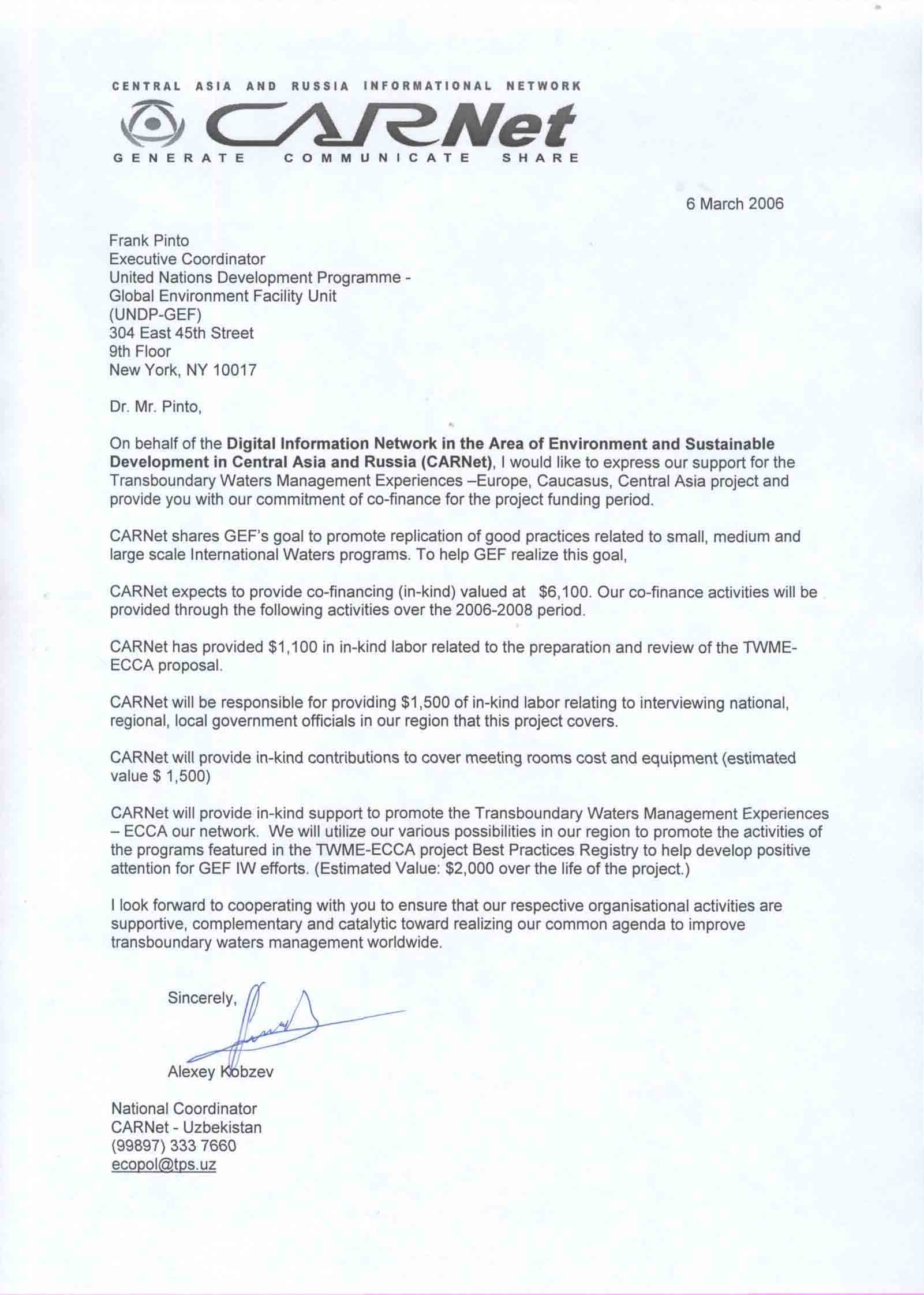
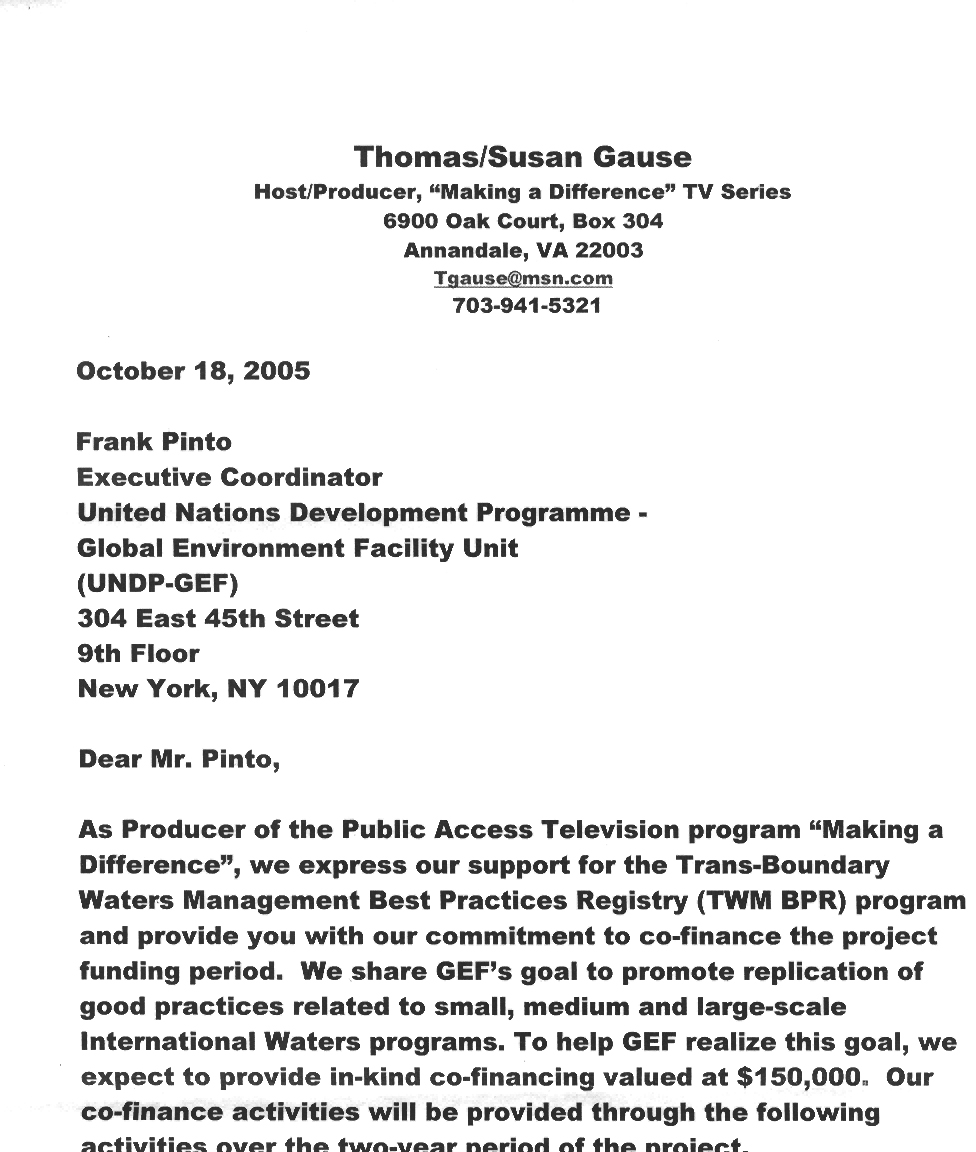
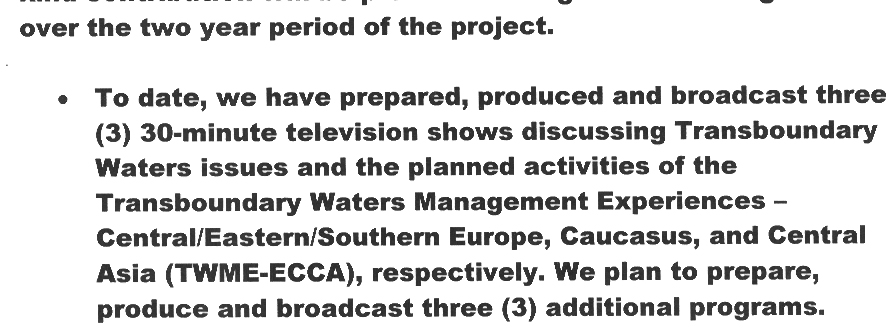
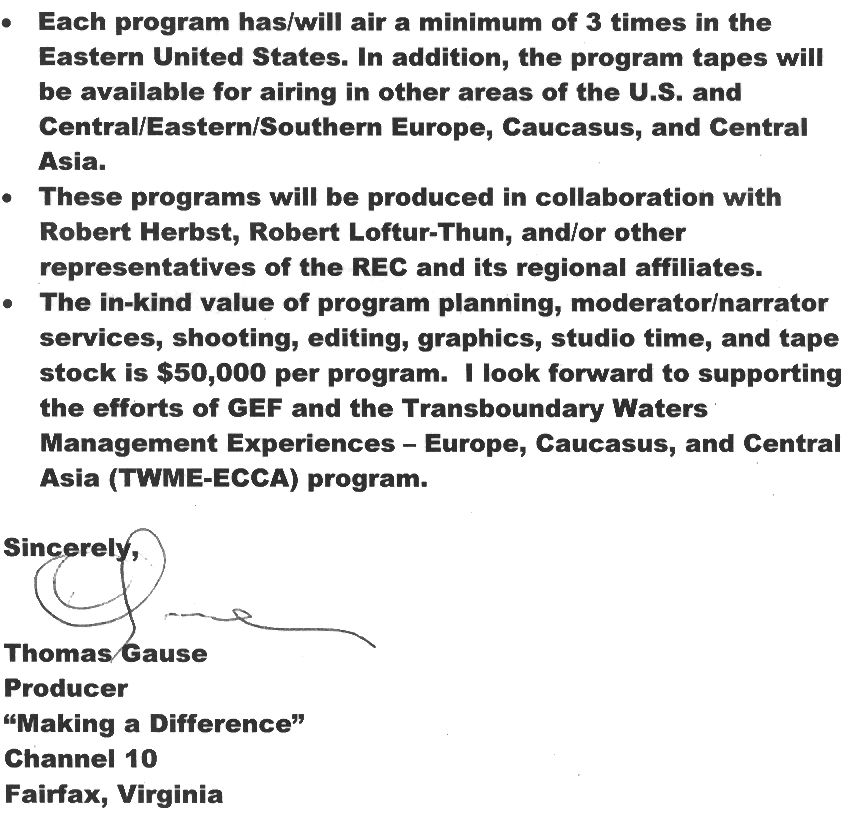






REGIONAL ENVIRONMENTAL CENTRE
September 26, 2005
r.
c
te
Frank Pinto
Executive Coordinator
n
a
t
i
o
n
a
l
c
h
ara
ter
United Nations Development Programme -
on of in
ti
Global Environment Facility Unit
za
g
a
ni
(UNDP-GEF)
al or
304 East 45th Street
n
-
p
o
l
i
tic
no
9th Floor
and
fit
New York, NY 10017
-pro
,
non
e
n
d
ent
Dear Mr. Pinto,
dep
in
an
is
On behalf of the Regional Environmental Centre Moldova, I would like to express our support
OVA
D
L
for the Transboundary Waters Management Best Practices Registry (TWM BPR) program and
provide you with our commitment of co-finance for the project funding period.
. REC-MO
al
a
ion
i
n
t
e
rn
REC Moldova shares GEF's goal to promote replication of good practices related to small,
er
r
a
ct
medium and large scale International Waters programs. To help GEF realize this goal, REC
u
ca
c
Moldova expects to provide co-financing (in-kind and/or in cash) valued at $ 90,660. Our co-
i
tic
p
ol
finance activities will be provided through the follow activities over the 2005-2007 period.
t,
n
on-
ofi
pr
n-
·
t
,
no
REC Moldova has provided $ 1,100 in in-kind labor related to the preparation of the
p
e
n
d
en
TWM BPR MSP proposal.
de
ie in
· REC Moldova will be responsible for providing $ 68,560 of in-kind labor relating to
n
i
za
ga
interviewing national, regional, local government officials in the 28 countries that this
s
t
e
o or
project covers.
A e
OV
D
· REC Moldova will provide cash and in-kind sponsorship to cover meeting rooms cost
and equipment (estimated value $ 17,000)
C-MOL
RE
· REC Moldova will provide in-kind support to promote the Transboundary Waters
Management Best Practices Registry through REC's network. REC Moldova will
Tel: (373 22)238685/ 238686; Fax:(373 22)238685; E-mail: info@rec.md, www.rec.md
57/1 Banulescu Bodoni str., of. 107, MD 2005, Chisinau, Moldova
REGIONAL ENVIRONMENTAL CENTRE
utilize our various possibilities in EECCA region to promote the activities of the
r.
programs featured in the Best Practices Registry to help develop partnerships and
c
te
positive attention for GEF IW efforts. (Estimated Value: $ 4,000 over the life of the
project.)
n
a
t
i
o
n
a
l
c
h
ara
ter
on of in
ti
I look forward to cooperating with you to ensure that our respective organizational activities are
za
g
a
ni
supportive, complementary and catalytic toward realizing our common agenda to improve
al or
transboundary waters management worldwide.
n
-
p
o
l
i
tic
no
and
fit
Sincerely,
-pro
,
non
e
n
d
ent
dep
in
an
is
OVA
D
L
Victor Cotruta,
Finance & Development Director
. REC-MO
al
REC Moldova
a
ion
i
n
t
e
rn
er
r
a
ct
u
ca
c
i
tic
p
ol
t,
n
on-
ofi
pr
n-
t
,
no
p
e
n
d
en
de
ie in
n
i
za
ga
s
t
e
o or
A e
OV
D
C-MOL
RE
Tel: (373 22)238685/ 238686; Fax:(373 22)238685; E-mail: info@rec.md, www.rec.md
57/1 Banulescu Bodoni str., of. 107, MD 2005, Chisinau, Moldova
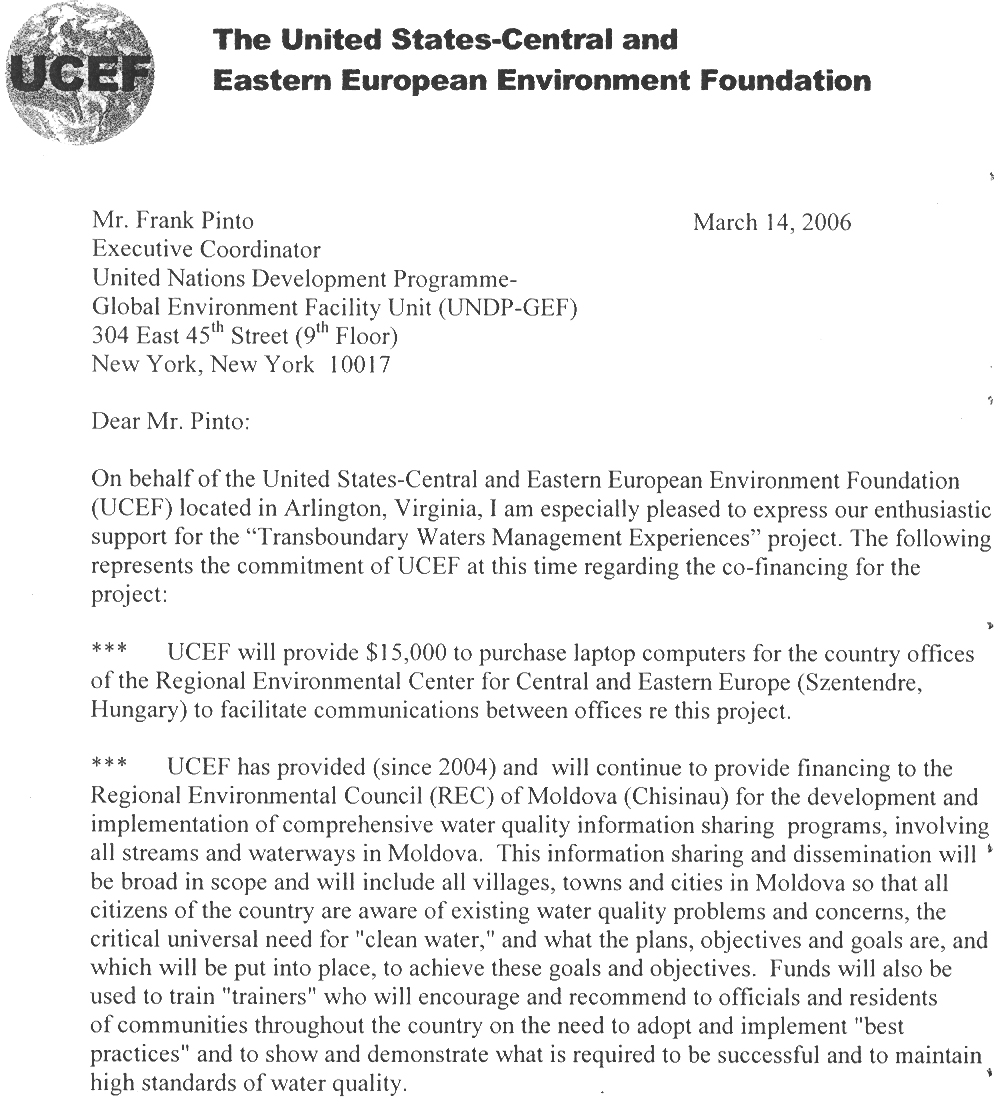
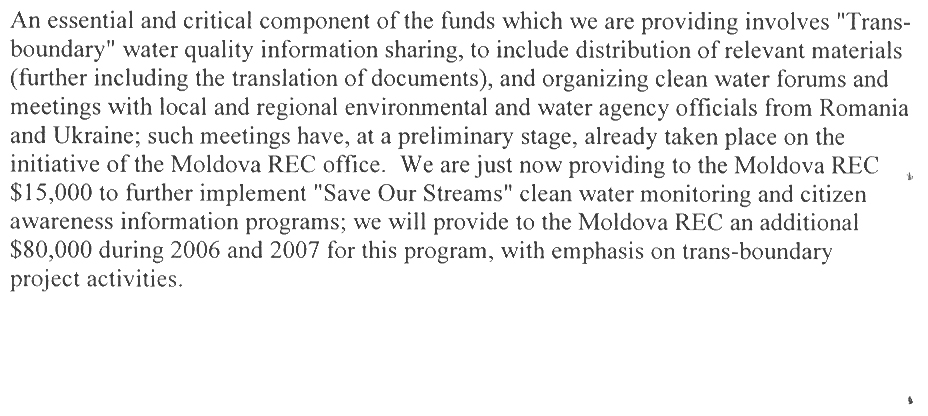
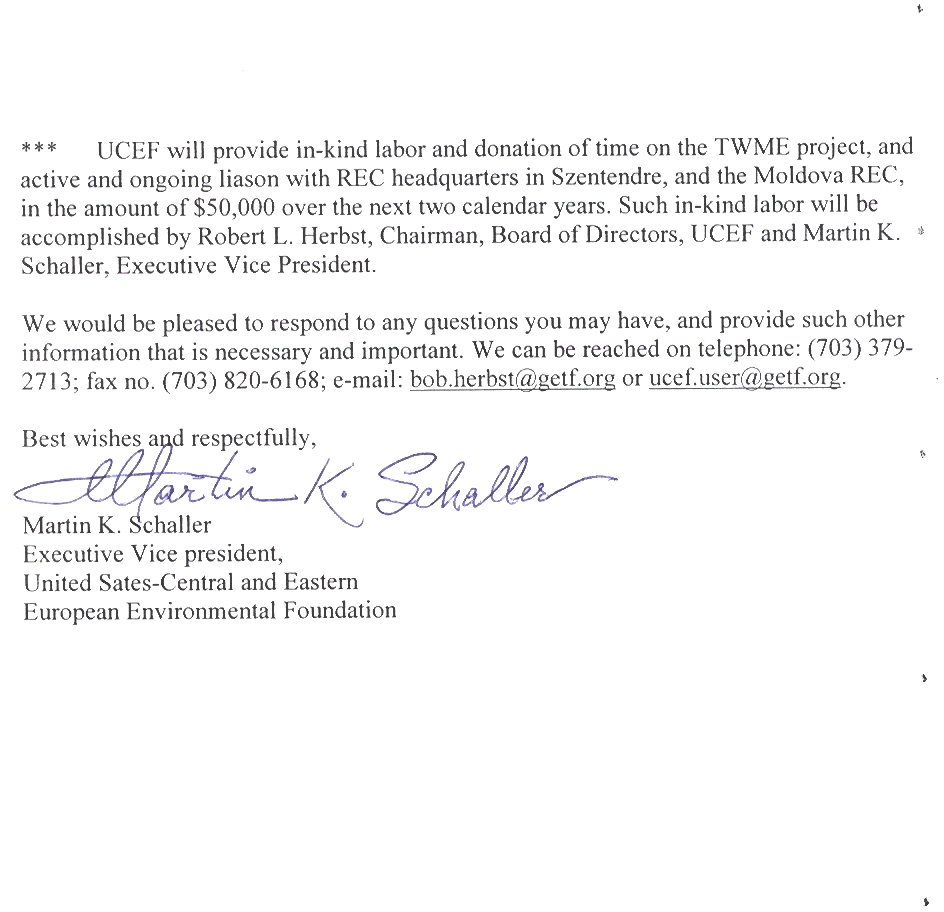
PART III:
Terms of Reference for
Key Project Staff and
Main Sub-Contracts

Robert L. Herbst
Co-Founder & Principal
The Global Environment & Technology Foundation
Robert L. Herbst has over 50 years successful experience as a business, environmental and conservation
executive. He has an excellent record of domestic and international success in Administration, Budget Planning,
Public Speaking, Writing, Press Relations, Decision Making, Negotiation, Fund Raising, Lobbying, Natural
Resources, and Employee Relations. Mr. Herbst served as Assistant Secretary for Fish, Wildlife, National Parks
and Acting Secretary for the U.S. Department of Interior. The Carter White House recognized him as one of the
"Best" subcabinet administrators in government. Recently, Mr. Herbst was selected by the Clinton Administration
to be America's Board Member of the Regional Environmental Center for Central and Eastern Europe. He has
received over 600 Awards for his administrative, environmental and public service accomplishments. In 2003, he
was enshrined in the National "Fresh Water Fishing Hall of Fame" and also was presented the "Outstanding
Achievement Award" from the University of Minnesota (the highest award at the University). In 2005, the
University of Minnesota enshrined his name on the wall of honor as one of the Universities most outstanding
alumni.
A summary of work history is listed below:
Global Environment & Technology Foundation, Arlington, VA
Chairman of the Board & CEO, 1996-1998; Co-Founder
Global Environment & Technology Foundation (GETF) is a 501 (c) (3) not-for-profit corporation that fosters
innovation by uniting the environment, technology, and enterprise for sustainable practices throughout the world.
As Chairman of the Board and CEO, Mr. Herbst facilitated the Foundation's mission by ensuring financial
integrity and identifying new and diverse business opportunities that would enhance, promote or complement the
existing Foundation programs and mission.
A-55 Limited Partnership, Reno, NV
President, July 1997-January 1998
Senior Advisor, July 1997-Present
A-55 Limited Partnership is headquartered in Reno, Nevada and is today's leading manufacturer of high-
performance water-based fuels. As President, Mr. Herbst provided strategic vision and formulated a coherent
strategy for the use of A-55 Clean Fuels in the utility and power industries. He continues to be an advisor to A-55
Limited Partnership for the integration of A-55 Clean Fuels in the national and international markets.
Tennessee Valley Authority, Washington, DC
Washington Representative, April 1992-October 1996
The Tennessee Valley Authority (TVA) is a government owned corporation that conducts a unified program of
resource development for the advancement of economic growth and environmental leadership in the seven-state
Tennessee Valley region. TVA has an annual budget of $5.5 billion and a staff of 17,000 employees. As a
Washington Representative, Mr. Herbst represented TVA with the U.S. Federal Government, Executive and
Congressional branches as well as with non-governmental conservation organizations and trade groups.
Lake Superior Center, Duluth, MN and Washington, DC
President, November 1990-April 1992
The Lake Superior Center for Freshwater Understanding is a non-profit corporation formed to build and operate
an international freshwater public educational center at Duluth, Minnesota and Lake Baikal, Russia. The Center's
mission is unique: to inspire an ethic of conservation and foster responsible use of fresh water through
interpretation of global environmental issues affecting Lake Superior and other large lakes of the world. As
President, Mr. Herbst developed international and national partnerships. He also organized fund raising,
administered ongoing educational programs and initiated international programs.
Trout Unlimited, Vienna, VA
Executive Director, March 1981-November 1990
Trout Unlimited is an international conservation organization with membership in U.S., Canada, New Zealand,
Spain, Japan, West Germany, and France. As Executive Director, Mr. Herbst administered agreements with the
U.S.S.R., the People's Republic of China, and Yugoslavia and supervised 30 member staff and over 67,000 U.S.
members.
During his service at Trout Unlimited, Mr. Herbst's major accomplishments included: Increasing number of
chapters from 225 to 485 and increasing membership by almost five fold (13,400 to 67,000), increasing annual
income by eight times ($320 thousand to $3 million); leading successful legislative activities on fishery policies
and budgets in Congress; creating the Living Bright Water Program which resulted in projects to improve fish
habitat in 30 states in 139 rivers
U.S. Department of Interior, Washington, DC
Assistant Secretary for Fish, Wildlife, and National Parks, 1977-1980
Acting Secretary, 1981
As Acting Secretary, Mr. Herbst supervised over 100,000 employees with an annual budget of over $7 billion.
He supervised the U.S. Fish and Wildlife Service, National Park Service, Heritage Conservation and Recreation
Service, and chaired four major commissions. Mr. Herbst was architect of Alaska Lands Bill recommendations to
the Administration (protected 115 million acres of land). This legislation passed in the fall of 1980 and was the
most important Conservation Bill ever passed by Congress.
Mr. Herbst's major accomplishments over the four years he served the Department of Interior of the U. S.
Government included: Tripling National Wildlife Refuge system; doubling National Park acreage; tripling the
nation's Scenic Rivers; doubling the nation's land trails and substantially improving the Appalachian Trail;
developing Non-Game Program; developing Urban Recreation Program; implementing Barrier Island and Coastal
Study of Atlantic and Gulf Coast; implementing Energy Conservation program which resulted in 30% energy
savings for three federal agencies; being recognized as having one of the "Best" Affirmative Action Programs in
Federal Government.
Minnesota Department of Natural Resources, St. Paul, MN
Commissioner and Deputy Commissioner,
February 1966-April 1969 and January 1971-February 1977
Mr. Herbst supervised the divisions of Fish and Wildlife, Forestry, State Parks, Waters, Mineral, Enforcement,
and Soil and Water Districts administering over 1,700-4,000 employees. He was appointed and served under four
governors and five administrations of both political parties.
During his years of service his major accomplishments included: being Minnesota's first Commissioner of
Natural Resources; reorganizing the agency for improved efficiency, cost, and service;
playing a major role in the passage and implementation of the most comprehensive set of the state conservation
laws in the nation; serving as the State's witness in the Reserve Mining Case regarding the pollution of Lake
Superior; establishing copper, nickel rules and regulations for leasing state land;
implementing many new programs such as natural areas, non-game management, environmental education, and
salary plan for employees; coordinating control of worst forest fire season in Minnesota's history (1976);
negotiating settlement of Leech Lake Indian lawsuit on hunting, fishing, and ricing.
Izaak Walton League of America, Glenview, IL
Executive Director, April 1969-January 1971
Mr. Herbst led this national conservation organization and supervised a staff of 12 persons and 60,000 members.
His major accomplishments included: Increasing membership and income; coordinating lobby effort for
citizen's Clean Water Crusade which resulted in $800 million appropriations from Congress for waste
treatment plants; leading participant in "Earth Day" project; initiating the successful lawsuit to stop mining in
"Boundary Waters Canoe Area" of Minnesota.
Keep Minnesota Green, Inc., St. Paul, MN
Executive Director, 1963-1966
As Executive Director, Mr. Herbst coordinated the State Programs of: Forest Fire Prevention Education; Tree
Farming; Conservation Education; and raised funds for its entire operational budget.
Minnesota Conservation Department, Cambridge, MN
Forester, 1957-1963
As Forester, Mr. Herbst led the preparation of over 2,000 Forest & Wildlife Management Plans for private and
public forests, and the planting or supervision of planting over 10 million trees. He also led efforts in Minnesota
for establishment of tree farms. In recognition for these efforts, The University of Minnesota chose Mr. Herbst as
the "Outstanding Forester in Minnesota" and also presented him the "Distinguished Service Award" and also
dedicated the University Yearbook in honor of him.
Education: B.S., Forest and Wildlife Management, University of Minnesota, 1957
Member of Alpha Zeta Honorary Fraternity

G.A. "Chuck" Chaitovitz
Principal
Global Environment & Technology Foundation
G.A. "Chuck" Chaitovitz is a communications and public policy professional with over 15 years of
experience specializing in environment, technology and homeland security issues. He serves as the
Washington point-of-contact for industry, not-for-profits and trade associations. Mr. Chaitovitz
possesses a strong issues-management background developed by running and growing his own
company, managing complex projects and working on Capitol Hill, including service on the House
Science Committee staff.
Mr. Chaitovitz is a Principal at the Global Environment & Technology Foundation and is also the co-
founder and Principal of The Coventry Group, L.L.P., a Virginia-based professional services firm
specializing in marketing, strategic communications and government and public relations. For TCG, Mr.
Chaitovitz helps corporations, municipalities and associations capitalize on legislative opportunities that
will benefit their business and the environment. He provides ongoing strategic counsel and
communications support for these clients around legislative issues, corporate positioning and crisis
situations. Mr. Chaitovitz brings in-depth knowledge of the legislative process, the environmental
security marketplace, homeland security strategies and the industries and organizations that can help
clients attain their business objectives. Mr. Chaitovitz has substantial experience working on strategic
planning and communications issues, including launching a coalition in support of geospatial technology
workforce development, and government relations programs for a robotics technology supporting
emergency preparedness and response objectives and for a uranium detection technology to address
nuclear proliferation and dirty bomb threats. He also has specialized in crisis communications for power
plant siting.
Mr. Chaitovitz' specialties include project management, strategic planning, business development,
policy analysis, legislative and regulatory proposal development and implementation, stakeholder
education and partnership building. Mr. Chaitovitz provided strategic planning, outreach and
partnership development services for the National Aeronautics and Space Administration's (NASA)
National Workforce Development Education and Training Initiative (NWDETI). This effort is modeled
after a successful NASA state-wide initiative designed to develop a trained workforce for the geospatial
technology industry through education and training in Mississippi. Results have included strategic
partnerships with key Federal, state and local governments and private sector organizations, alternative
government and private sector funding sources and more effective Federal coordination on geospatial
workforce issues.
He also provided program management, communications counsel and outreach services to a national
environmental performance partnership between more than 400 companies, 22 state departments of
environment, 84 local regulatory agencies and the U.S. Environmental Protection Agency. He
developed and implemented an outreach and education program to potential and current participants to
increase awareness and visibility. Results have included increased program participation and more
effective communication between all stakeholders.
Mr. Chaitovitz has also developed new market opportunities for innovative environmental technologies.
For example, Mr. Chaitovitz conducted extensive outreach to state governments with the greatest clean
air problems to promote new markets for innovative clean burning fuels. He involved a multitude of
public and private stakeholders to ensure the best regulatory environment possible for market entry. In
addition, Mr. Chaitovitz successfully included favorable legislative language in Federal highway
legislation providing potential access to close to $1.5 billion per year to assist with market entry.
Developing this kind of outreach process will deliver results for other corporate and government clients.
Prior to establishing The Coventry Group, Chuck spent nearly six years on Capitol Hill. Here, he
advised U.S. Congressman Jimmy Hayes (R-LA) on the feasibility and impact in a wide range of policy
areas, specializing in budget, defense, science, space, technology, environment, transportation, labor
and economic development issues. In this position, he served as committee staff and Special Assistant
to the Congressman during his tenure on the House Committee on Science's Subcommittee on Energy
and Environment. As a Senior Aide to Congressman Hayes, Chuck managed legislative activities and
provided oversight for proposals through the legislative process, including drafting of legislation, floor
statements, press releases, and hearing testimony.
Education: MBA, Marketing, University of Baltimore, BA, Mathematics, Franklin and Marshal
College